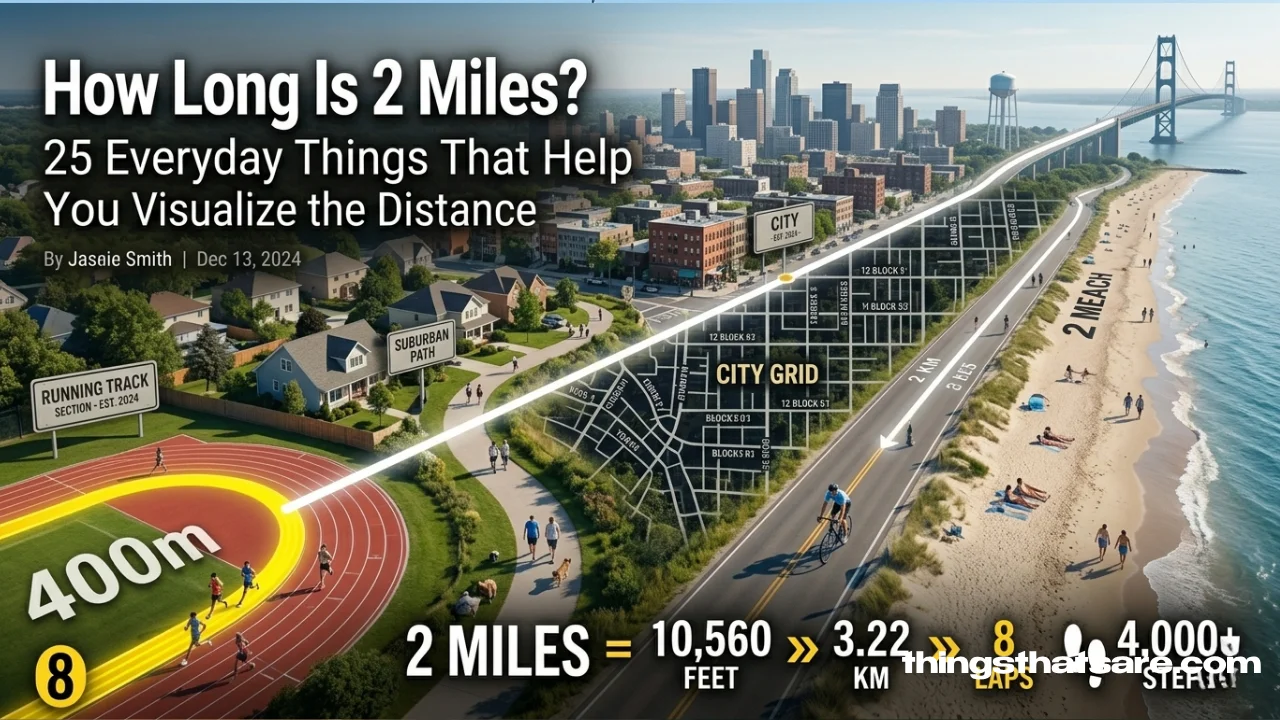
How Long Is 2 Miles? Most people hear 2 miles and draw a blank. The number alone means very little. But pair it with something familiar — a landmark, a walk, a real-world object — and it clicks instantly.
Whether you’re planning a walk, training for a run, or just curious about how far 2 miles really is, this guide breaks it down in ways that actually make sense.
What Does 2 Miles Actually Look Like?
Two miles equals 10,560 feet, 3,520 yards, or approximately 3.22 kilometers. That’s the math. But numbers alone don’t paint a picture — so let’s make it real.
Think of it this way: if you live in a typical American suburb, walking from your front door to a neighborhood park and back is often right around 2 miles. It’s a distance most people can cover comfortably on foot in under 40 minutes.
Quick 2-Mile Conversion Reference
| Unit | Equivalent of 2 Miles |
| Feet | 10,560 ft |
| Yards | 3,520 yards |
| Meters | 3,218.69 meters |
| Kilometers | 3.22 km |
| Steps (avg. stride) | ~4,000 – 4,500 steps |
| City Blocks (NYC) | ~35 – 40 blocks |
| Track Laps (¼-mile) | 8 laps |
| Pool Laps (25-yard) | ~141 laps |
How Long Does It Take to Cover 2 Miles?
Walking 2 miles at an average American pace of 3 to 3.5 mph takes roughly 34 to 40 minutes. For a brisk walker doing 4 mph, that drops to about 30 minutes.
Running 2 miles depends heavily on fitness level. Beginners finish in 20 to 25 minutes. Intermediate runners cover it in 14 to 18 minutes. Elite runners — think college track athletes — can clock under 9 minutes.
Driving 2 miles in city traffic typically takes 5 to 8 minutes. On a clear highway or suburban road, you’re looking at 3 to 4 minutes.
Cycling 2 miles on flat terrain takes a casual rider about 10 to 12 minutes. A road cyclist at 15 mph covers it in under 8 minutes.
| Mode of Travel | Approx. Time for 2 Miles | Calories Burned |
| Walking (avg. pace) | 34 – 40 min | ~160 – 200 cal |
| Running (beginner) | 20 – 25 min | ~220 – 260 cal |
| Running (intermediate) | 14 – 18 min | ~200 – 240 cal |
| Cycling (casual) | 10 – 12 min | ~100 – 140 cal |
| Driving (city) | 5 – 8 min | N/A |
25 Everyday Things That Are 2 Miles Long
The best way to visualize 2 miles is to compare it to things you already know. Here are 25 real-world examples — from iconic American landmarks to everyday routes — that put this distance into perspective.
Must Visit: 10 Things That Measure 300 Feet Long or Are Big (With Real-Life Examples)
Landmarks & Iconic Structures
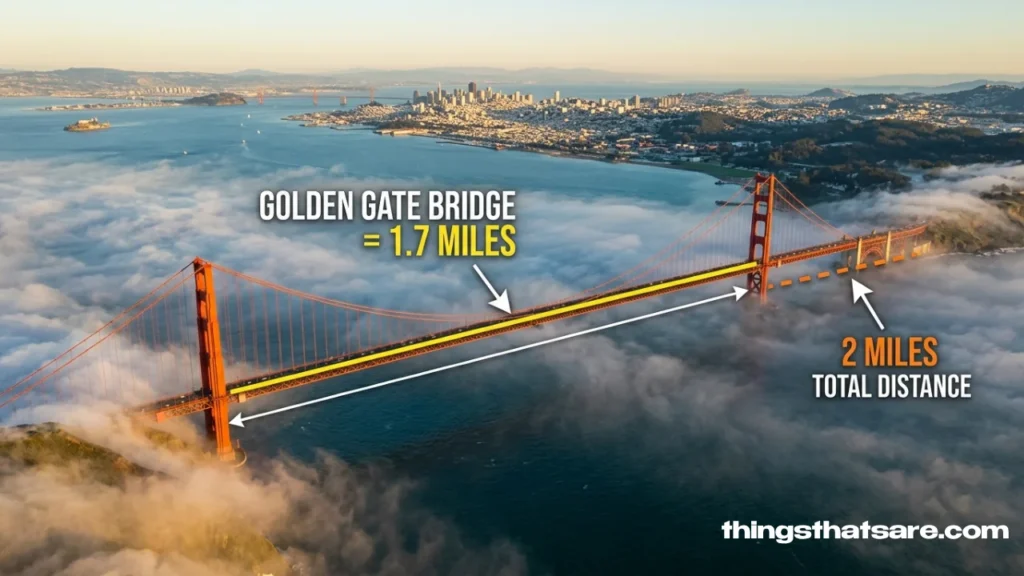
The Golden Gate Bridge walking path is approximately 1.7 miles from end to end. Two miles is just slightly longer — imagine crossing the bridge and continuing a few extra blocks into San Francisco.
Central Park in New York City has an outer perimeter loop of about 6.1 miles. Two miles represents roughly one-third of that full loop — a solid morning stroll through the park.

The Las Vegas Strip stretches about 4.2 miles from Mandalay Bay to the Stratosphere. Two miles is almost exactly half of the Strip — roughly from MGM Grand to the Bellagio and a little beyond.

The National Mall in Washington, D.C. runs from the Lincoln Memorial to the U.S. Capitol — a distance of about 1.9 miles. Two miles is just barely longer than this famous stretch of American history.

A typical American airport runway system often spans 1.5 to 2.5 miles across its layout. Two miles gives you a sense of the scale of a major hub like O’Hare or LAX.

Roads, Routes & Tracks
35 to 40 city blocks in Manhattan equals roughly 2 miles. In New York City, 20 north-south blocks equal about 1 mile, so 2 miles is about 40 blocks headed uptown or downtown.

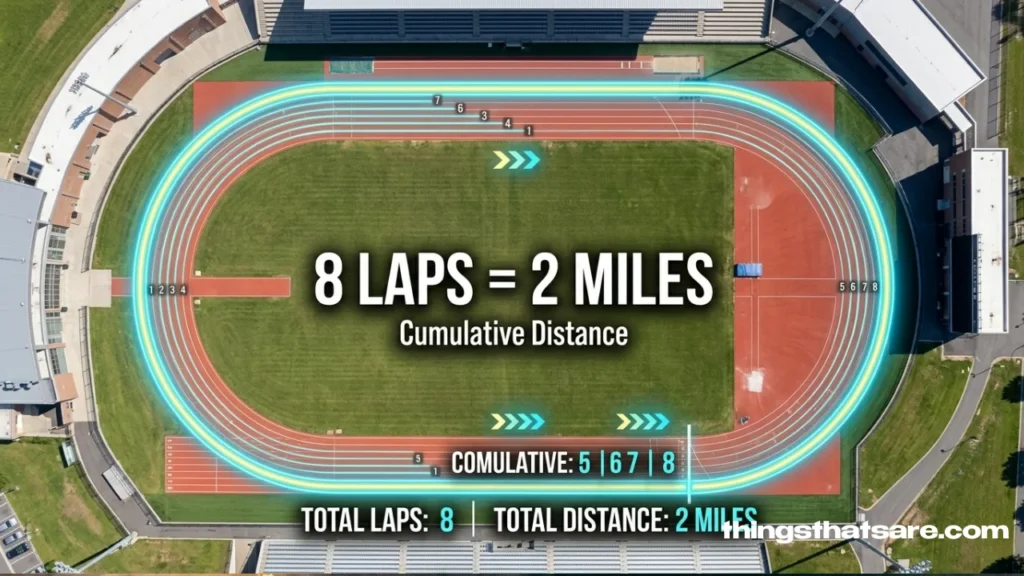
Eight laps around a standard ¼-mile track equals exactly 2 miles. This is why the 2-mile run is a staple in U.S. high school track and field — it’s a clean, countable distance.
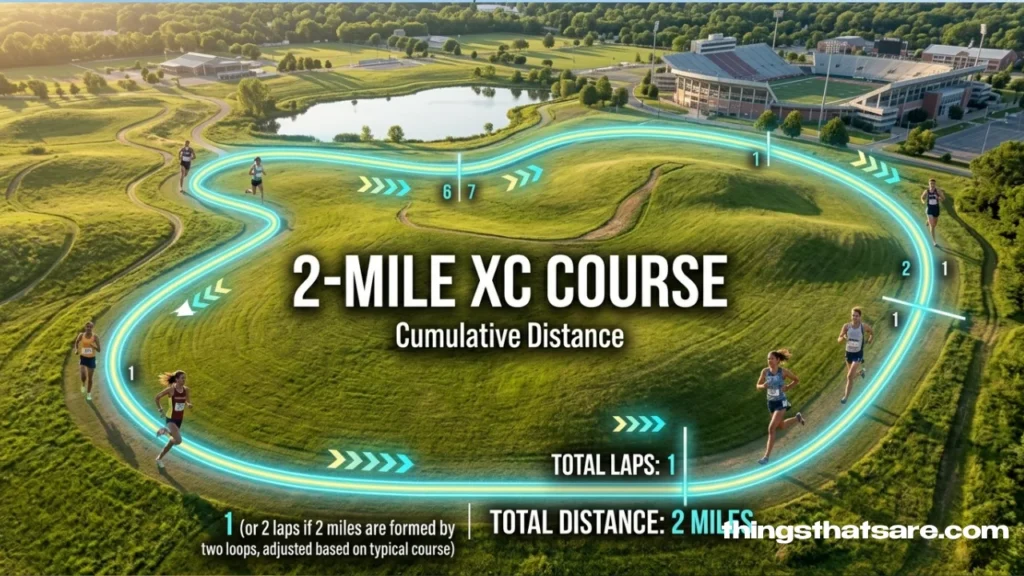
A standard cross-country course in American high schools typically runs 2 to 3 miles. Two miles marks the entry point for competitive distance running at the scholastic level.
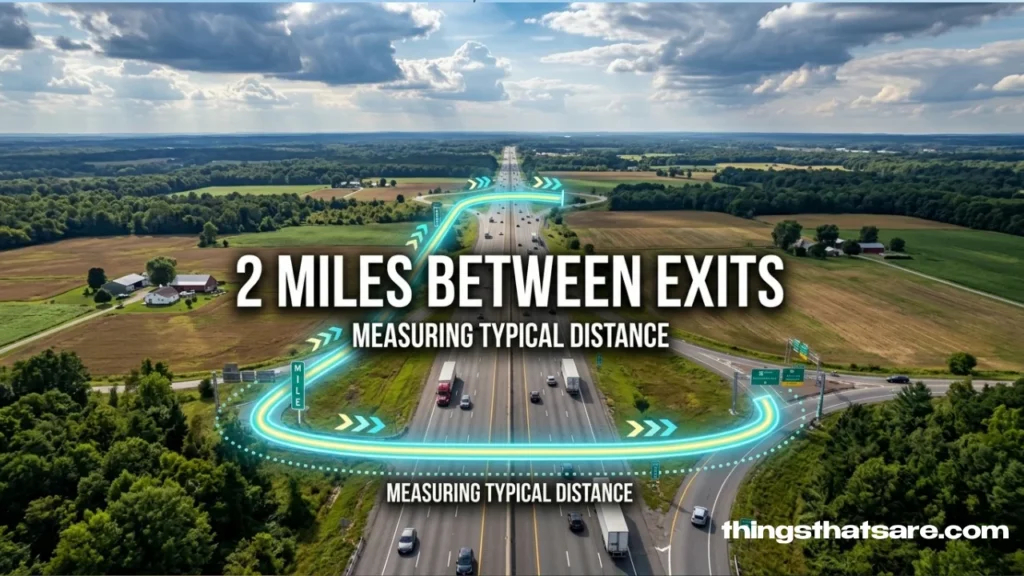
Two miles of interstate highway between exits is common in rural U.S. states. If you’ve ever driven through Kansas or Nebraska, you know how fast 2 miles passes — and yet how far it feels on foot.
A typical neighborhood delivery route segment for USPS or UPS couriers often covers about 2 miles per pass. That’s the chunk a mail carrier walks in a single neighborhood loop.

Nature & Open Spaces
A 2-mile stretch of beach shoreline is deeply visualizable for anyone who has walked along the coast. In popular spots like Santa Monica Beach or Virginia Beach, 2 miles takes you past dozens of lifeguard stations and thousands of sunbathers.

A small community lake shoreline at a local park or reservoir often measures 1.5 to 2.5 miles around. Circumnavigating your neighborhood lake? That’s likely your 2-mile marker.

A forest hiking loop in a state park — common across the U.S. — is frequently designed around a 2-mile circuit. It’s the most popular loop length for recreational hikers at parks like Shenandoah, Zion, and Acadia.

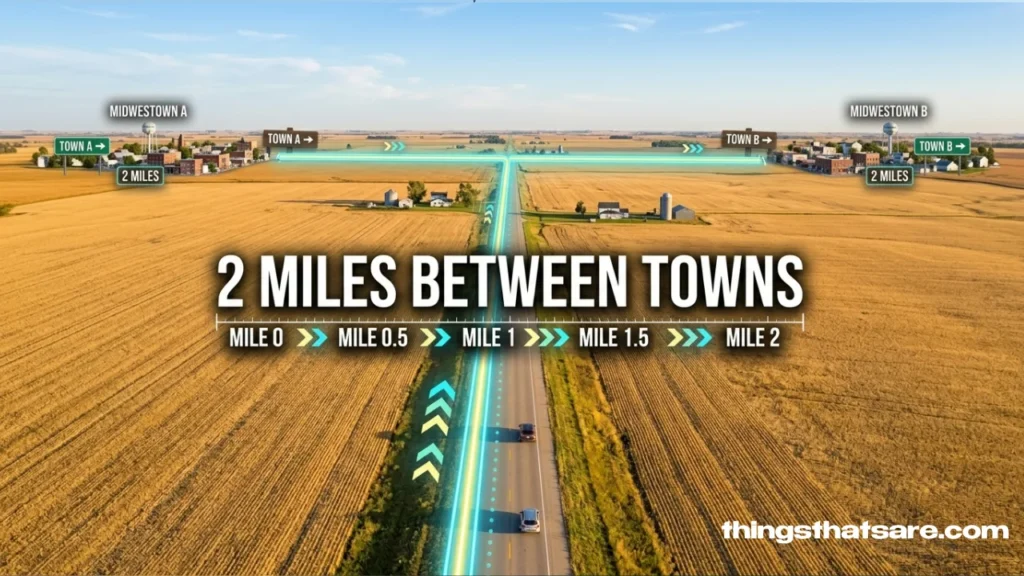
The distance between two small Midwestern towns is often just 2 miles. In rural Illinois, Ohio, or Iowa, neighboring towns can be separated by nothing more than a few cornfields and a 2-mile straight road.
A typical greenway or urban trail through American cities — like the Atlanta BeltLine, Nashville’s Greenway, or Denver’s Cherry Creek Trail — is built in 2-mile sections. Two miles is the sweet spot for recreational trail design.

Everyday Life & Relatable Comparisons
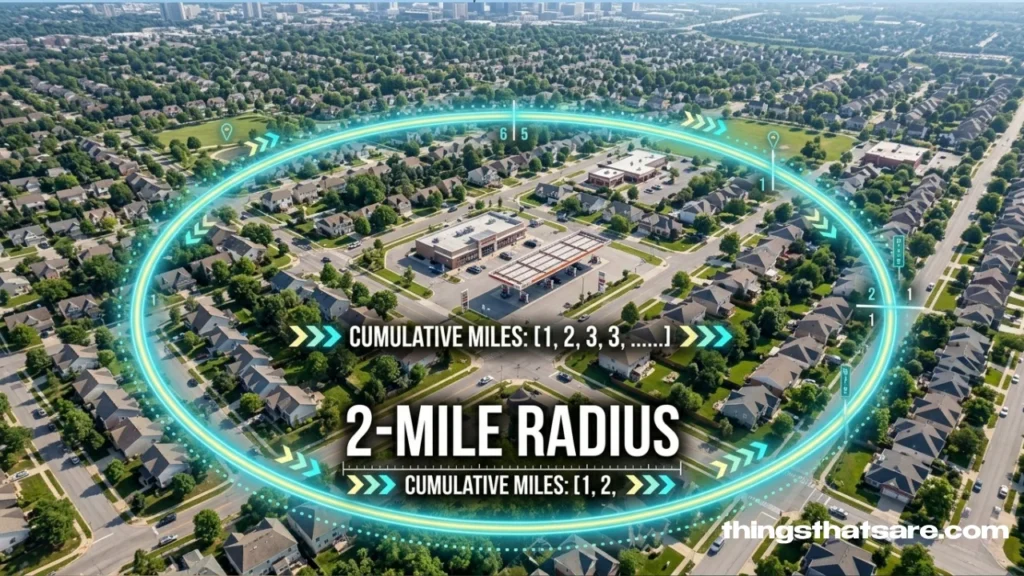
The average American lives within 2 miles of a gas station. According to the U.S. Energy Information Administration, gas station density in suburban areas puts most households within a 2-mile radius of a fuel stop.
A school bus route segment in a suburban district often covers 2 miles per neighborhood loop. Bus drivers repeat these 2-mile circuits multiple times each morning and afternoon.

The distance between two suburban shopping centers is commonly 1.5 to 2 miles — just far enough that most Americans will drive it rather than walk it, even though it’s a perfectly walkable distance.
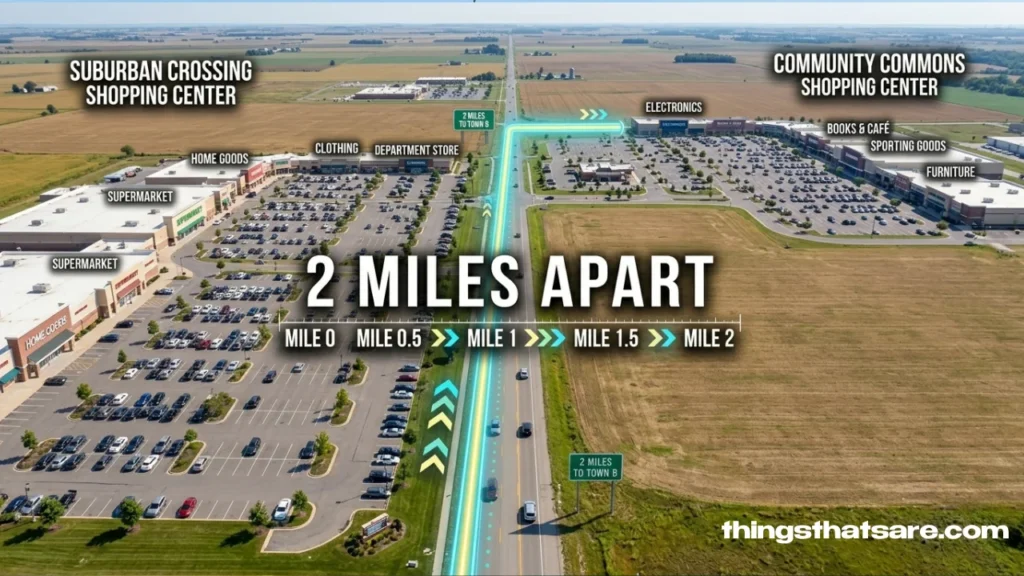
Walking the length of a typical American strip mall district — including the parking lot frontage road — from one anchor store to another often spans close to 2 miles in larger suburban corridors.

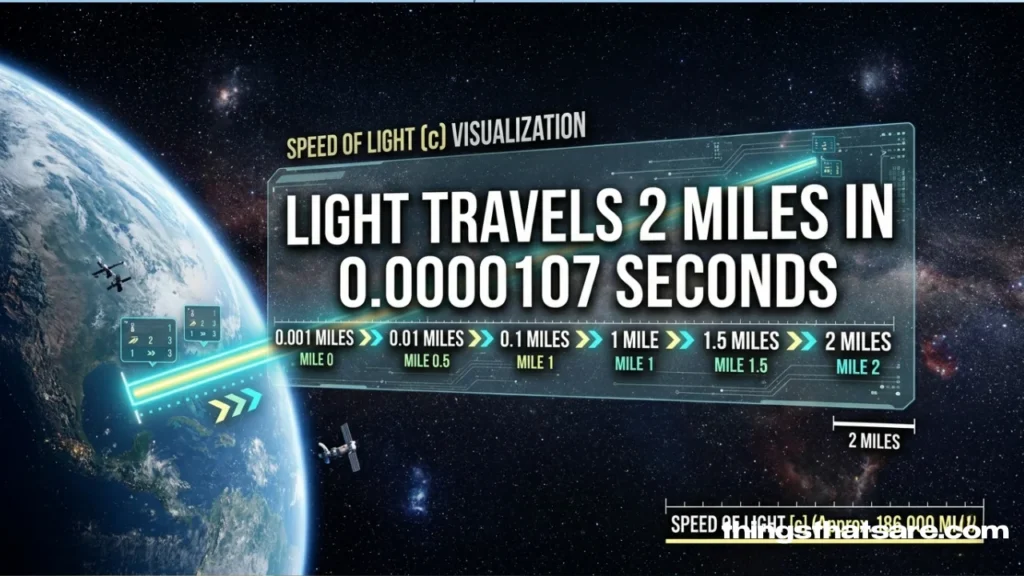
Two miles is about the distance light travels in 0.0000107 seconds. That’s a fun physics anchor — it reminds you that 2 miles, while very walkable for a human, is barely a blink at the speed of light.
Sports & Athletic References
The U.S. Army Physical Fitness Test (APFT) — now updated to the ACFT — traditionally required soldiers to run 2 miles as part of their fitness evaluation. A passing score for a 17-21 year old male required completing it in under 15 minutes and 54 seconds.

The 2-mile run in high school track and field is one of the most prestigious distance events. For reference, the national high school record for boys stands at 8 minutes, 9 seconds — world-class speed that most runners can only dream about.

Elite distance runners — think sub-4-minute milers — can cover 2 miles in under 8 minutes. For the average recreational runner, the goal is simply to finish 2 miles without stopping.

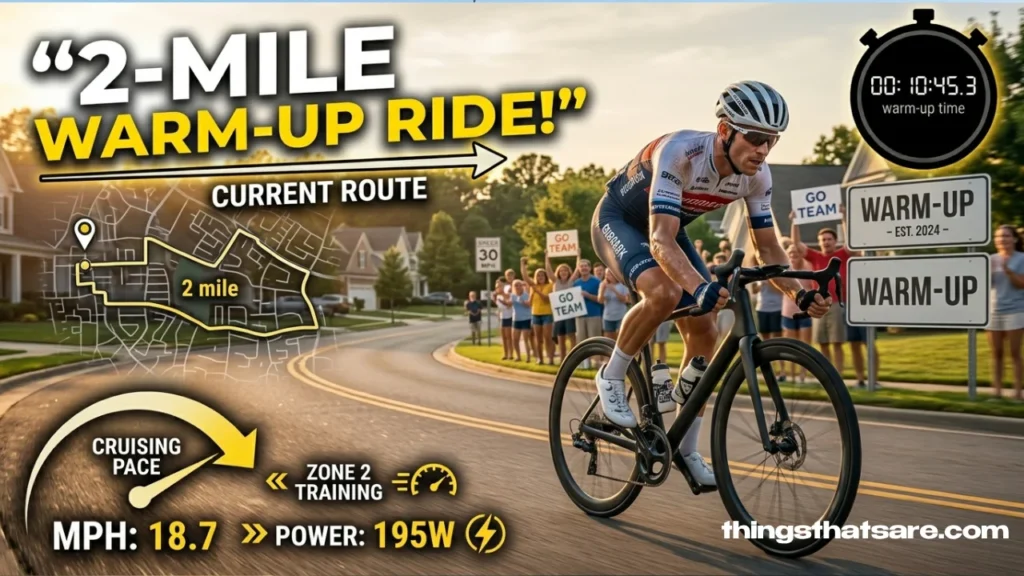
A cyclist’s warm-up distance before a serious training ride is typically 2 miles. Road cyclists use 2 miles to get the legs moving and heart rate elevated before pushing harder.
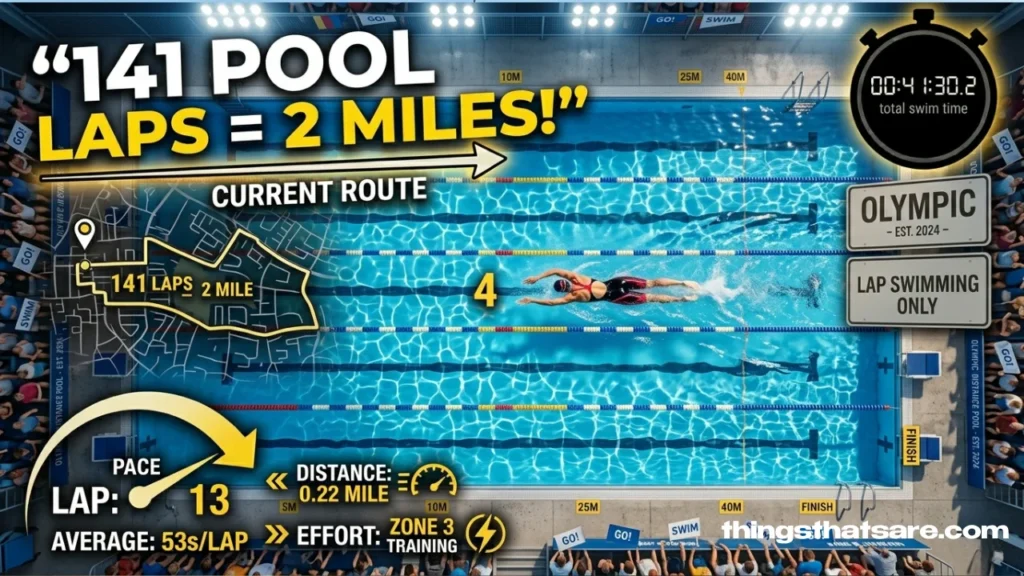
In swimming, the equivalent of a 2-mile open-water swim is approximately 3,520 yards — or roughly 141 laps in a standard 25-yard pool. Competitive open-water swimmers in events like USA Triathlon regularly tackle this distance.
Why 2 Miles Matters for Your Health & Daily Life
Two miles is not a random benchmark. It sits right at the intersection of achievable and meaningful for most American adults.
The CDC recommends at least 150 minutes of moderate aerobic activity per week for adults. Walking 2 miles a day — which burns roughly 160 to 200 calories depending on your body weight — fits neatly into that guideline and can be completed in a single 35-minute session.
For beginner runners, 2 miles is the first real milestone. Programs like Couch to 5K are built around reaching this distance. Hitting 2 miles without stopping gives new runners the confidence to push toward a full 5K (3.1 miles).
For weight management, walking 2 miles daily burns roughly 56,000 to 73,000 calories per year — the equivalent of 16 to 21 pounds of body fat, assuming consistent effort and diet control.
Urban planners and walkability researchers consider 2 miles the outer limit of what most Americans will walk for a destination. Studies from the Victoria Transport Policy Institute show that pedestrian trips rarely exceed 2 miles in U.S. cities without transit support.
In terms of commuting, 2 miles is the distance at which cycling becomes significantly faster than driving in dense urban areas — a fact that e-bike advocates and city planners increasingly cite when building cycling infrastructure.
FAQs
What objects weigh 2 lbs?
Several common household items weigh approximately 2 pounds: a quart of milk (1 quart = 2.09 lbs), a 1-liter soda bottle filled with liquid, a standard hardcover novel, a small laptop charger, and a 2-lb bag of all-purpose flour. In a gym context, a pair of light hand weights used for telemedicine strength exams often starts at the 2-lb mark.
What household item weighs 3 lbs?
A standard toaster weighs about 3 lbs — this is one of the most cited examples in workplace weight guides. Other items in this range include a 32-oz container of protein powder, a small cooking pot, a medium-sized hardcover textbook, and a 32-oz water bottle when full.
Which is most likely to weigh 2 pounds?
Among common household candidates, a quart of milk is the most accurate 2-pound benchmark. A 1-quart container holds approximately 2.09 lbs of liquid. A 2-lb bag of granulated sugar is another near-perfect match. Both are widely available and consistently weigh within a few ounces of 2 lbs.
What weighs 2 grams?
Two grams is an incredibly small unit of mass — roughly the weight of a single U.S. dollar bill (which weighs exactly 1 gram) doubled. Other examples: two standard paperclips (each weighs ~1.1g), a small AAA battery cap, or two raisins. At 2 grams, you’re operating at a scale where a precise digital kitchen scale is needed for accuracy.
What household object weighs 1 gram?
A single paper clip weighs approximately 1 gram — this is the most universally cited 1-gram reference. Other examples include a thumbtack, a small stick of chewing gum (without the wrapper), a single M&M candy, or about ¼ teaspoon of water. The gram is the base unit of mass in the metric system and equals 1/1000th of a kilogram.
Is 2 grams heavy?
No — 2 grams is extremely light. To put it in perspective: 1 pound equals 453.59 grams. So 2 grams is less than 0.5% of a single pound. You would barely feel 2 grams placed in the palm of your hand. At this scale, even gravity’s pull is nearly imperceptible without sensitive measuring equipment.
What is 2 grams of sugar?
Two grams of granulated sugar is approximately ½ teaspoon. Nutritionally, it delivers exactly 8 calories (at 4 calories per gram of carbohydrate). This is a particularly relevant measurement for people managing blood sugar levels, following low-carb diets, or reading nutrition labels — where sugar content is listed in grams.
How big is 2.5 grams?
2.5 grams is slightly more than the weight of two U.S. dollar bills combined. In practical terms, it’s comparable to a short pencil stub, 5 paperclips, or a small sugar packet (which typically holds 4 grams, so 2.5g is just over half a packet). It’s a measurement commonly encountered in nutrition labels, pharmaceutical dosing, and precision cooking.
What exactly is 1 gram?
One gram is the base unit of mass in the metric system — equal to 1/1000th of a kilogram and approximately 0.035 ounces. In everyday life, 1 gram is best understood as the weight of a single paperclip, a small thumbtack, a single raisin, or about ¼ teaspoon of water. On a nutrition label, 1 gram of fat contains 9 calories, while 1 gram of protein or carbohydrate contains 4 calories.
2 Miles by the Numbers — Complete Conversion Cheat Sheet
Need a fast reference for 2-mile distance conversions? Here’s the most complete quick-reference table available — including units that most other guides overlook entirely.
| Measurement | 2 Miles Equals | Notes |
| Feet | 10,560 ft | Standard U.S. measurement |
| Yards | 3,520 yards | Used in football fields (1 field = ~120 yards, so 2 mi ≈ 29 football fields) |
| Meters | 3,218.69 m | International standard |
| Kilometers | 3.22 km | Common in global races |
| Steps | ~4,000–4,500 | Based on avg. 2.5-ft stride |
| City Blocks (NYC) | ~35–40 blocks | North-south direction |
| Track Laps (¼-mile) | 8 laps | Standard outdoor track |
| Pool Laps (25-yard) | ~141 laps | Competitive short-course pool |
| Pool Laps (50-meter) | ~64 laps | Olympic-length pool |
| Football Fields | ~29 fields | End zone to end zone |
Pro Tip: If you want to measure 2 miles without GPS, count your steps. Most adults take between 2,000 and 2,500 steps per mile — so 4,000 to 5,000 steps gets you to the 2-mile mark depending on your stride length.
Conclusion
Two miles is more than just a number. It’s a walk through your neighborhood. It’s 8 laps around a track. It’s the U.S. Army fitness standard and the first real milestone for beginner runners.
Whether you’re measuring it in feet, kilometers, steps, or city blocks — 2 miles is a distance that belongs in your everyday reference toolkit. Now you know exactly what it looks like, how long it takes, and why it matters.