Ever needed to measure something but had no ruler nearby? You’re not alone. Whether you’re shopping online, working on a DIY project, or helping your kid with a school assignment — knowing what 1 inch looks like in real life saves time and prevents costly mistakes.
The good news? Things that are 1 inch long are literally all around you right now and by visit this page you can also try size comparison tool. Once you know what to look for, you’ll never feel lost without a measuring tape again.
How Long Is 1 Inch? (Size + Conversion Facts)
One inch is a standard unit of length in the imperial measurement system — the system used daily across the United States for construction, retail, manufacturing, and screen sizing.
Officially, 1 inch equals exactly 2.54 centimeters. That definition has been internationally agreed upon since 1959 by the International Yard and Pound Agreement. So when a product listing says 1-inch mounting hole or a sewing pattern calls for 1-inch seam allowance, this is the precise size being referenced.
The fastest physical anchor? The width of an adult male’s thumb is roughly 1 inch — a trick carpenters and builders have used for centuries, long before the tape measure existed.
Quick Conversion Reference:
| Unit | Equivalent to 1 Inch |
| Centimeters | 2.54 cm |
| Millimeters | 25.4 mm |
| Feet | 0.0833 ft |
| Yards | 0.0278 yd |
| Meters | 0.0254 m |
For American readers: the inch dominates everyday life in ways metric countries don’t experience. From lumber dimensions at Home Depot to TV screen sizes to clothing measurements — the inch is embedded into U.S. trade and retail at every level.
Also Visit: 18 Common Things That Are 14 Inches Long (Real-Life Size Examples)
25+ Common Things That Are 1 Inch Long
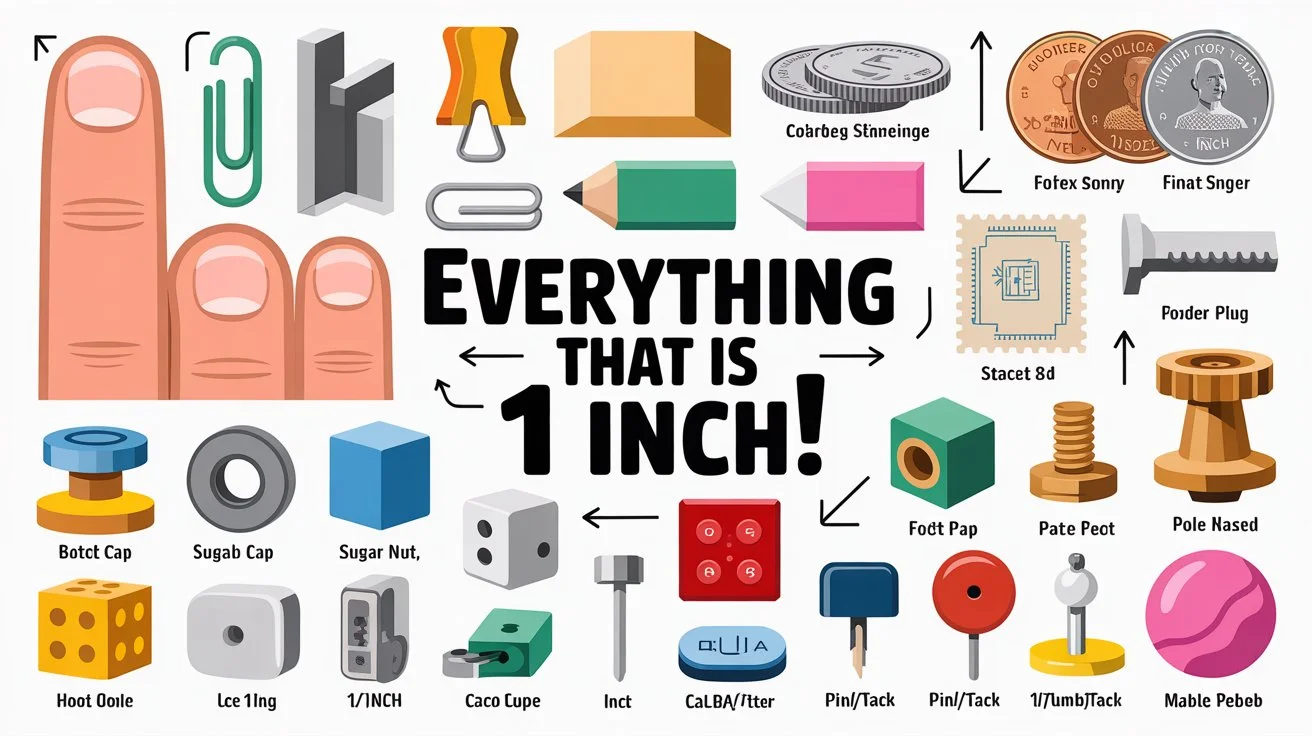
Below are 25+ real-world objects grouped by category. Find your best personal reference fast — and keep it in mind whenever you need a quick size comparison.
Body References — The Most Convenient 1-Inch Tools You Own
Your own body is your most reliable measuring tool. These body-based references are always with you — no tools required.
| Object | Measurement Detail | Category |
| Adult Male Thumb Width | ~1 inch across widest part | Body Reference |
| Index Finger — Tip to First Knuckle | ~1 inch for most adults | Body Reference |
| Pinky Fingernail Width | Close approximation (smaller hands) | Body Reference |

Expert Tip: Measure your own thumb once with a ruler. Most adult men land between 0.9 and 1.1 inches. Women’s thumbs typically run 0.8–0.9 inches. Once you know your personal offset, your hand becomes a calibrated measuring tool you carry everywhere.
The phrase rule of thumb actually traces back to this practice. Craftsmen used thumb width as an informal measurement standard for centuries — long before standardized rulers became common.
The index finger segment — from fingertip to the first knuckle joint — is a bonus reference most people overlook. Check yours. It’s surprisingly accurate.
Coins & Currency — 1-Inch References Already in Your Wallet
Coins are manufactured to precise government specifications, making them among the most reliable informal measuring tools available.
| Object | Measurement Detail | Category |
| US Quarter (diameter) | 0.955 inches — closest coin to 1 inch | Currency |
| Stacked Pennies (thickness) | ~15 pennies stacked = 1 inch height | Currency |
| Half Dollar (edge reference) | Useful diameter comparison | Currency |

The US Quarter is the gold standard no-ruler coin reference. At 0.955 inches in diameter — confirmed by the U.S. Mint’s official coin specifications — it’s close enough for 95% of everyday estimates. The 0.045-inch gap (roughly the thickness of a credit card) won’t matter for casual comparisons.
The stacked pennies trick is underused. Each US penny is 1.52 mm thick. Stack 17 pennies and you’re sitting at almost exactly 1 inch of height. This is especially useful when measuring depth or clearance gaps in woodworking and home repair.
Also Visit: 25+ Things That Are 100 Feet Tall or 100 Feet Long
Office & School Supplies — 1-Inch References at Every Desk
Look around your desk right now. Several items there measure approximately 1 inch — most people just never think to use them as references.
| Object | Measurement Detail | Category |
| Standard Paperclip (short side) | ~1 inch | Office Supply |
| Mini Binder Clip (clip width) | ~1 inch | Office Supply |
| Basic Pencil Sharpener (width) | ~1 inch diameter | Office Supply |
| Small Pink Eraser | ~1 inch long | Office Supply |
| Opened Office Staple (end to end) | ~1 inch | Office Supply |
| Postage Stamp (width) | ~1 inch | Office Supply |
| Keyboard Ctrl Key Width | ~1 inch on full-size keyboards | Office/Tech |

The paperclip is a standout reference. Its short side — the inner loop end — measures just under 1 inch. Keep one in your wallet and you have a portable measuring tool that costs nothing.
US postage stamps are held to strict USPS dimensional standards. Their consistent width makes them a dependable informal reference — especially for crafters and scrapbookers working with tight spaces.
An opened office staple stretched flat runs almost exactly 1 inch end to end. It’s one of the least-known size references — and one of the most precise for something you’ll find in any classroom or office in America.
Hardware & Home Tools — 1-Inch References in Every Toolbox
This is where most measurement blogs fall short. Hardware provides some of the most precise 1-inch reference objects available — because they’re manufactured to strict engineering specifications.
| Object | Measurement Detail | Category |
| Standard Hex Nut (across flats) | 1 inch — per standard bolt/nut size charts | Hardware |
| 1-Inch Pipe Fitting (nominal size) | Industry-standard nominal sizing | Plumbing |
| Furniture Dowel Plug (length) | ~1 inch — standard flat-pack size | Furniture |
| Small Furniture Glide / Felt Pad | ~1 inch diameter | Home |
| Wood Screw Head (common size) | ~1 inch head diameter | Hardware |
| Small Metal Eyelet (outer diameter) | ~1 inch | Craft/Hardware |
Hex nuts are manufactured to ANSI/ASME B18.2.2 standards. A standard 1-inch hex nut measures exactly 1 inch across its flat faces — making it one of the most precisely sized portable references you can keep in a toolbox.
The nominal pipe sizing system confuses a lot of people. A 1-inch pipe fitting doesn’t measure exactly 1 inch on its outer diameter — nominal refers to a standardized reference name used by the American National Standards Institute (ANSI). But plumbers and contractors reference it constantly as a size landmark.
Furniture dowel plugs from flat-pack furniture (IKEA and similar brands) come in standardized lengths — often exactly 1 inch. Save extras from your next build and drop one in your junk drawer as a permanent size reference.
Everyday Household Items — 1-Inch Objects You Touch Daily
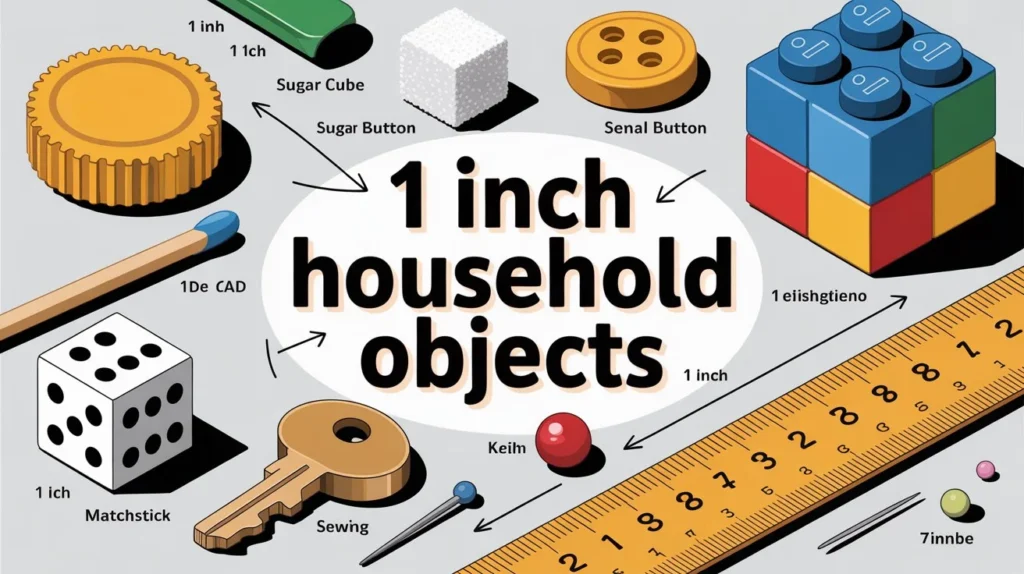
These are the objects most people don’t realize are measuring tools. They’re in your kitchen, your board game box, your sewing kit — and they’re approximately 1 inch in at least one dimension.
| Object | Measurement Detail | Category |
| Standard Bottle Cap (diameter) | ~1 inch | Kitchen/Household |
| Sugar Cube (side length) | ~1 inch per side | Kitchen |
| Small Button (coat/blazer) | ~1 inch diameter | Clothing |
| LEGO 1×1 Brick (height) | ~1 inch stud to base | Toys |
| Standard Dice (one side) | ~1 inch per face | Games |
| Matchstick (head to one-third) | ~1 inch segment | Household |
| Small Padlock Key Head | ~1 inch width | Hardware |
| Sewing Pin / Thumbtack | ~1 inch total length | Craft/Office |
| Small Pebble or Marble | ~1 inch diameter (approximate) | Nature/Toys |

LEGO bricks are engineered to extraordinary precision — tolerances of 0.002 mm. That consistency makes a LEGO 1×1 brick a surprisingly reliable informal measuring tool. The height from base to top of the stud is almost exactly 1 inch.
Standard tabletop gaming dice (the kind in Monopoly, Yahtzee, or Dungeons & Dragons sets) are manufactured at 16mm per face — which is 0.63 inches. Slightly under 1 inch, but the diagonal measurement across a face is close to 1 inch, making it a useful visual anchor.
A sugar cube gives you a three-dimensional understanding of 1 inch — you feel both the length AND height simultaneously. That’s something a flat coin can’t offer. For kids learning measurement concepts, this hands-on object works exceptionally well.
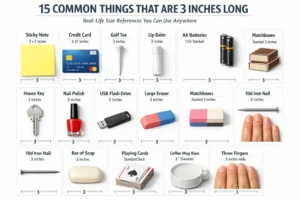
Must Visit: 15 Common Things That Are 3 Inches Long (Real-Life Size Examples You Can Actually Picture)
Tech & Accessories — Modern 1-Inch References Around You
Technology has given us a new category of consistent, standardized 1-inch references — because electronic components are manufactured to global specifications.
| Object | Measurement Detail | Category |
| AirPods Height (approximate) | ~1–1.22 inches (varies by model) | Tech |
| Credit Card Chip Area (width) | ~1 inch | Finance/Tech |
| Mini Keychain Carabiner (width) | ~1 inch | Accessories |
| USB-A Port (width) | ~0.98 inch — near 1 inch | Tech |
| Soda Bottle Cap (diameter) | ~1 inch | Tech/Household |

Apple AirPods dimensions: AirPods 3 stand 1.21 inches tall; AirPods 4 measure 1.19 inches; AirPods Pro 2 reach 1.22 inches. All three are close enough to 1 inch to serve as a useful modern reference.
The USB-A port is one of the most overlooked size references. Its width is standardized by the USB Implementers Forum (USB-IF) at approximately 0.98 inches — barely a whisker under 1 inch. Since USB-A ports appear on virtually every computer, laptop, and charging hub in America, this is one reference you’re never far from.
The EMV chip area on credit and debit cards maintains a consistent width governed by ISO/IEC 7816 standards — the international specification for chip cards. That consistency makes it a reliable size anchor regardless of which bank issued your card.
How to Measure 1 Inch Without a Ruler
Sometimes a tape measure isn’t within reach. Here are six proven, practical methods for estimating 1 inch without any measuring tool — ranked by accuracy and availability.
1. Thumb Method — Press your thumb flat against a surface. The width across the widest part is approximately 1 inch for most adult men. Measure yours once with a ruler to know your personal offset.
2. The Quarter Trick — A US quarter measures 0.955 inches in diameter. For quick everyday estimates, this gap is negligible. Keep one in your wallet specifically as a measuring coin.
3. Paperclip Method — The short side of a standard paperclip runs close to 1 inch. It’s one of the most portable size references available — and free.
4. Opened Staple Method — Flatten a standard office staple and measure end to end. It hits almost exactly 1 inch. Perfect for classroom and office use.
5. Stacked Pennies Method — Stack 15–17 pennies. You’ll land right around 1 inch of height. Useful specifically for measuring depth, clearance, and thickness — dimensions a flat coin can’t help with.
6. Binder Clip Method — The mini binder clip’s clip width (not the handles) is approximately 1 inch. Grab one from your desk for an instant no-ruler reference.
Expert Closing Tip: Pick ONE reference object from this list. Verify it once with a ruler. Memorize it. That single habit eliminates guesswork permanently — and turns everyday objects into a portable measurement system.
Why Knowing 1 Inch Matters (Practical USA Applications)
Online Shopping — Product listings constantly reference 1-inch dimensions. 1-inch mounting holes, 1-inch clearance required, 1-inch screen bezel. Without a physical anchor, shoppers guess — and returns happen. Knowing what 1 inch looks like prevents expensive ordering mistakes.
DIY & Home Improvement — Drilling pilot holes, spacing tile grout lines, installing drywall anchors, cutting trim — all require precision at the 1-inch scale. According to the National Association of Home Builders, the vast majority of residential construction in the U.S. uses imperial measurements exclusively.
Sewing & Crafting — The 1-inch seam allowance is the most common measurement in American sewing patterns. Button sizing, fabric cutting, ribbon width, trim application — one inch appears constantly in fiber arts and textile crafts.
Teaching Kids Measurement — Abstract numbers don’t stick. Handing a child a checker piece, a bottle cap, or a LEGO brick and saying this is 1 inch creates a concrete, tactile memory that no worksheet can replicate. It builds foundational mathematical measurement skills that carry through grade school.
Professional Trades — Carpentry, plumbing, electrical work, HVAC installation — the skilled trades industry in the U.S. operates almost entirely in imperial units. Understanding 1 inch by sight and feel is a baseline competency for anyone entering the trades.
Medical & Health Contexts — Wound sizing, bandage width selection, medical device specifications, dermatology measurements — clinical settings regularly reference 1-inch dimensions. Nurses and EMTs often use finger width as a quick field estimate when precise tools aren’t immediately available.
FAQs About 1-Inch Measurements
| Q: What is an example of 1 inch? |
| A: A US quarter coin (0.955 inches in diameter), the short side of a standard paperclip, or the width of an adult male’s thumb are the three most reliable everyday examples of 1 inch you can find without a ruler. |
| Q: Which finger is 1 inch long? |
| A: No full finger measures exactly 1 inch. However, for most adults, the distance from the tip of the index finger down to the first knuckle joint is approximately 1 inch — a built-in reference most people never think to use. |
| Q: What is comparable to 1 inch? |
| A: A standard dice face, a plastic bottle cap diameter, a LEGO 1×1 brick height, a mini binder clip width, or a USB-A port width are all comparable to 1 inch. These are reliable references you likely have within arm’s reach right now. |
| Q: What size is 1 inch? |
| A: 1 inch equals exactly 2.54 centimeters, 25.4 millimeters, or 0.0833 feet. In physical terms, it’s roughly the width of an adult male’s thumb — small but one of the most-used measurements in American daily life. |
| Q: How does 1 inch look like? |
| A: Picture the face of a standard board game dice, a plastic bottle cap, or your thumb pressed flat on a surface. Any of these gives an accurate, instant mental image of what 1 inch looks like in real life. |
| Q: How to find 1 inch without a ruler? |
| A: Use your thumb width, a US quarter coin, the short side of a paperclip, a flattened office staple, or a bottle cap diameter. All are proven no-ruler methods for estimating 1 inch accurately in everyday situations. |
Conclusion
1 inch is everywhere — in your wallet, on your desk, in your toolbox, and even on your own hand. The moment you connect this measurement to something physical, it stops being an abstract number and becomes something you can see and feel instantly.
Your three best everyday references: your thumb width, a US quarter, and a standard dice face. Pick one, verify it once with a ruler, and own it. That small habit builds the kind of measurement intuition that saves time on every project, purchase, and estimate you’ll ever make.