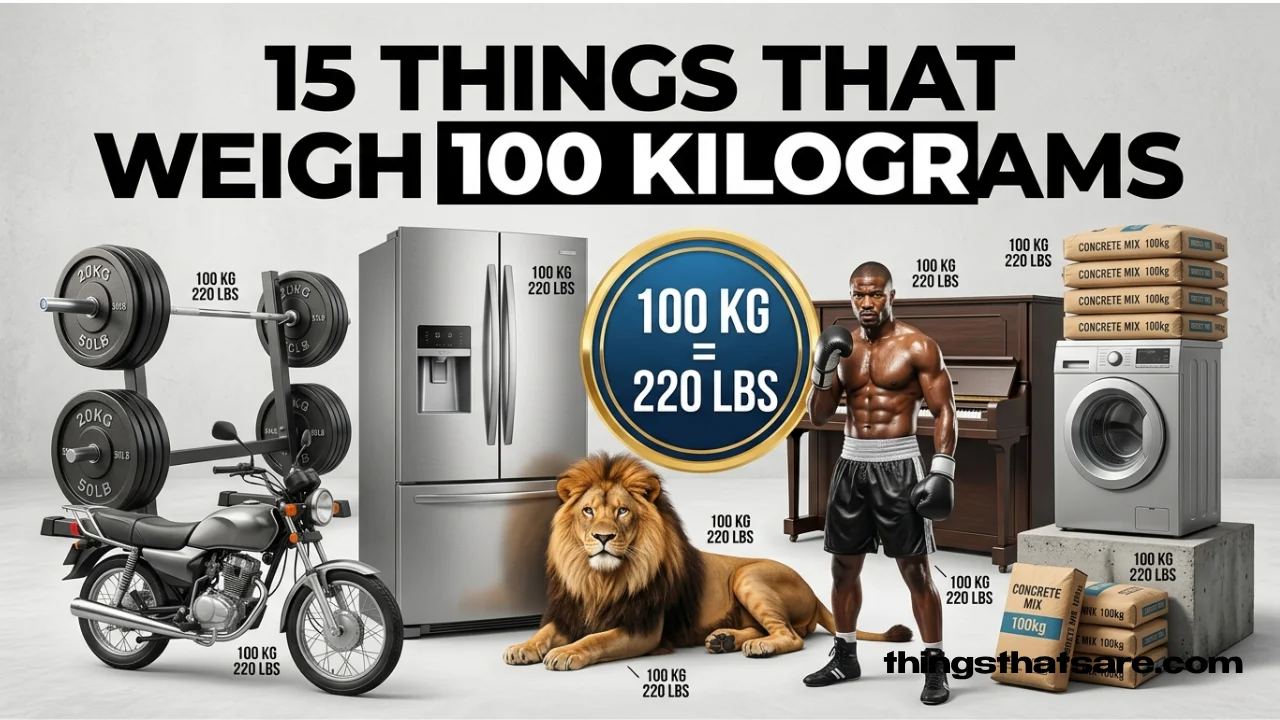
Most people hear ‘100 kg‘ and go blank. It’s a number with no picture attached.
This guide fixes that. Below you’ll find 15 real, familiar things that weigh 100 kilograms exactly — or very close to — 100 kilograms (220.46 lbs). From wild animals to gym equipment to everyday household items, every example is grounded in verified data. By the end, you’ll never look at a refrigerator, a lion, or a bag of cement the same way again.
What Is 100 Kilograms? (Quick Weight Breakdown & Conversions)
100 kg is a standard unit of mass in the metric system. It’s used globally in science, fitness, shipping, and everyday life.
In the United States, where imperial units dominate, understanding 100 kg in pounds is the fastest way to make it click. The exact conversion: 100 kg equals 220.46 lbs. To do the math yourself, multiply any kilogram value by 2.20462.
Here is the full unit conversion breakdown at a glance:
| Unit | 100 kg Conversion |
| Pounds (lbs) | 220.46 lbs |
| Stone | 15.75 stone |
| Grams | 100,000 g |
| Metric Tons | 0.1 metric ton (tonne) |
| Ounces | 3,527.4 oz |
| Newtons (force) | ~980.7 N on Earth’s surface |
How Heavy Is 100 kg Compared to an Average Person?
According to the CDC, the average American man weighs about 199.8 lbs (90.6 kg). So 100 kg puts you roughly 22 lbs above the average U.S. male — a completely real, human-scale reference.
In trade and agriculture, 100 kilograms is sometimes called a metric quintal. It is also important to note that 100 kg is not a ton — one metric ton equals 1,000 kg, making 100 kg just one-tenth of a full tonne.
15 Everyday Things That Weigh 100 Kilograms – Real-Life Examples
Each example below is drawn from manufacturer specifications, zoological records, agricultural standards, and fitness industry benchmarks. These are not estimates — they are documented weight ranges that include or sit precisely at the 100 kg mark.
Adult Male Lion
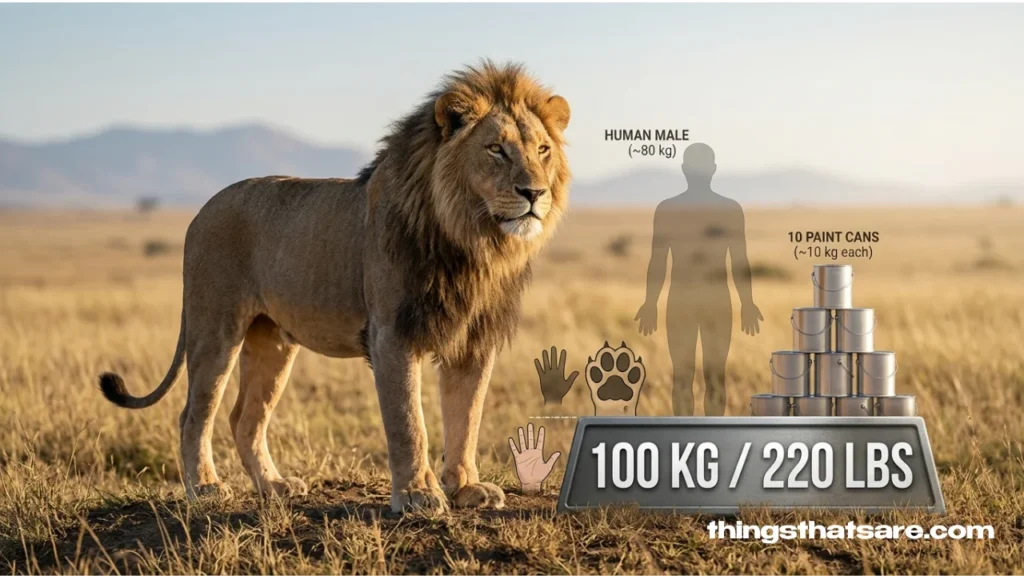
A fully grown male African lion typically weighs between 180 and 250 kg. However, adolescent male lions — around 18 months old — hit the 100 kg mark. Female lions (lionesses) average between 120 and 180 kg, with younger females also landing near this weight.
African lions outweigh their Asiatic cousins due to differences in diet, habitat, and genetics. This makes the lion one of the most dramatic and memorable animal comparisons for 100 kilograms in real life.
Standard Full-Size Refrigerator
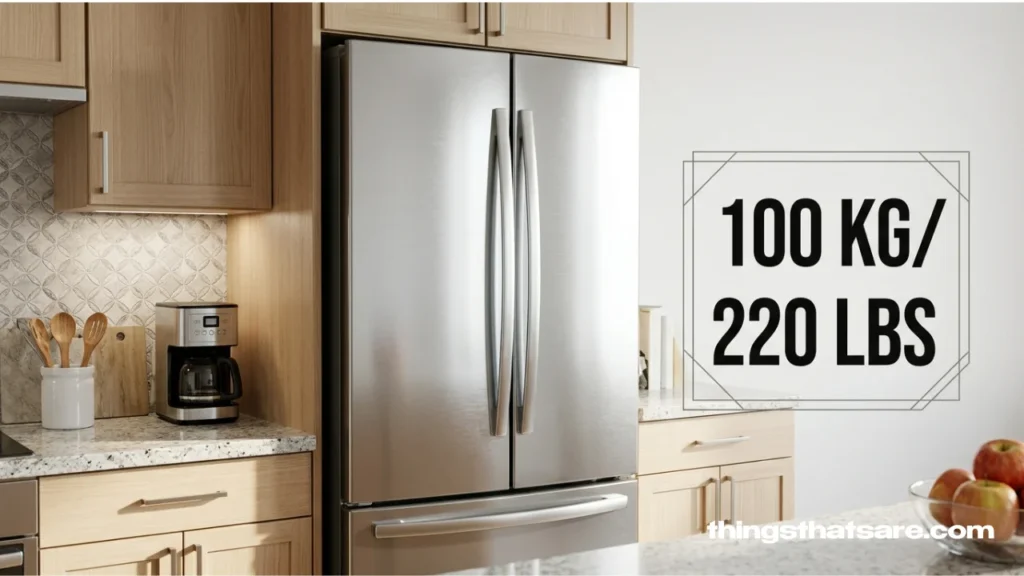
Most full-size household refrigerators weigh between 90 and 110 kg when empty. This places the average fridge squarely at the 100 kilogram weight class.
The weight comes from the compressor unit at the base, thick insulation panels lining every wall, and the steel exterior shell. This is exactly why moving a refrigerator almost always requires two people or a dolly.
Must Visit: 15 Common Things That Weigh 50 Pounds (With Real-Life Examples)
Front-Loading Washing Machine

Front-loading washing machines typically weigh between 95 and 105 kg. That extra weight isn’t accidental — engineers deliberately add concrete counterweights inside each machine.
These concrete blocks prevent violent shaking during high-speed spin cycles. They can account for 30 to 40 kg of the machine’s total mass — nearly one-third of its entire 100 kg weight.
Olympic Barbell with Weight Plates

In competitive powerlifting and weightlifting, 100 kg is a major milestone. A standard men’s Olympic barbell weighs 20 kg (44 lbs). Add 80 kg of iron weight plates and you reach exactly 100 kilograms total.
Gym culture calls this the ‘100 kg benchmark’ — a goal in deadlifts, squats, and bench press programs at training facilities across the USA. Athletes like strength-sport competitors use this as a progression marker.
Four Bags of Cement (25 kg Each)
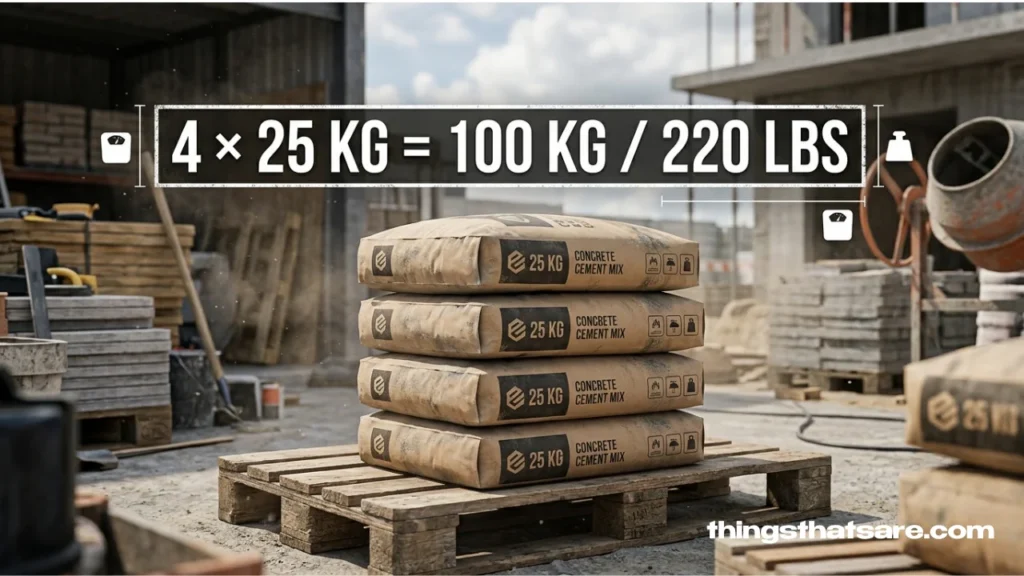
Standard construction-grade cement bags sold at Home Depot or Lowe’s weigh 25 kg (55 lbs) each. Stack four of them and you have exactly 100 kilograms of dead weight.
NIOSH (National Institute for Occupational Safety and Health) considers this near the upper safe manual lifting limit for trained construction workers. This weight is handled daily on U.S. job sites during foundation pours, driveways, and structural builds.
Small Motorcycle or Scooter

Lightweight motorcycles and scooters in the 250cc class frequently hit the 100 kg mark when accounting for fluids and a partial fuel tank. The Vespa Primavera comes in at approximately 114 kg, while sport 250cc bikes often land right at 100 kg.
This weight class makes small motorcycles manageable for a single rider to maneuver in tight urban spaces — one of the key reasons they dominate city commuting across the USA and globally.
Adult Male Gorilla
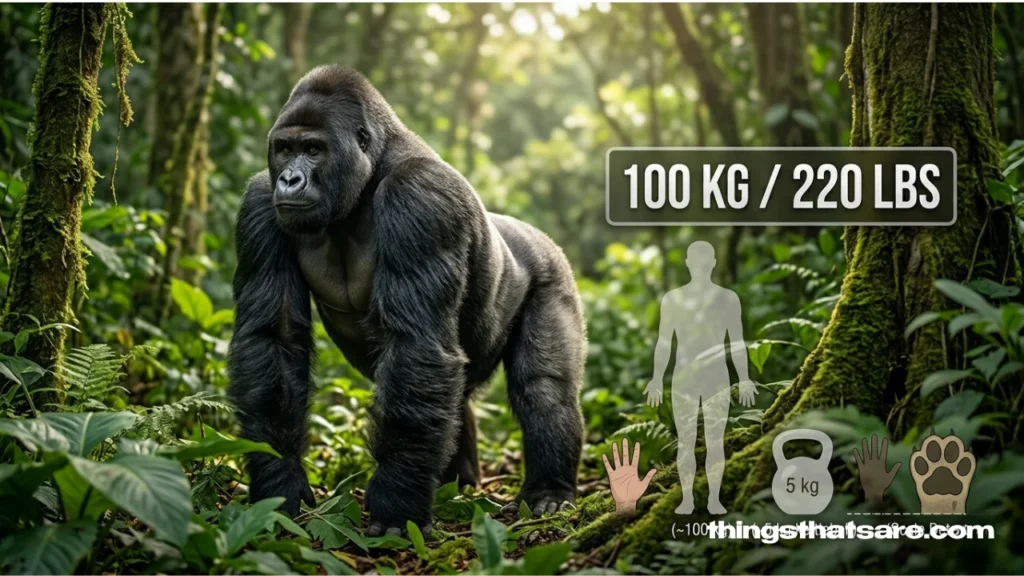
A large adult male gorilla — often called a silverback — typically weighs between 100 and 180 kg in the wild. Younger adult males frequently sit right at the 100 kg threshold.
Despite their size, gorillas are primarily herbivores. Their mass comes from dense muscle tissue, not fat — making the gorilla one of the best pound-for-pound strength references in the animal kingdom.
Ten 10 kg Bags of Rice
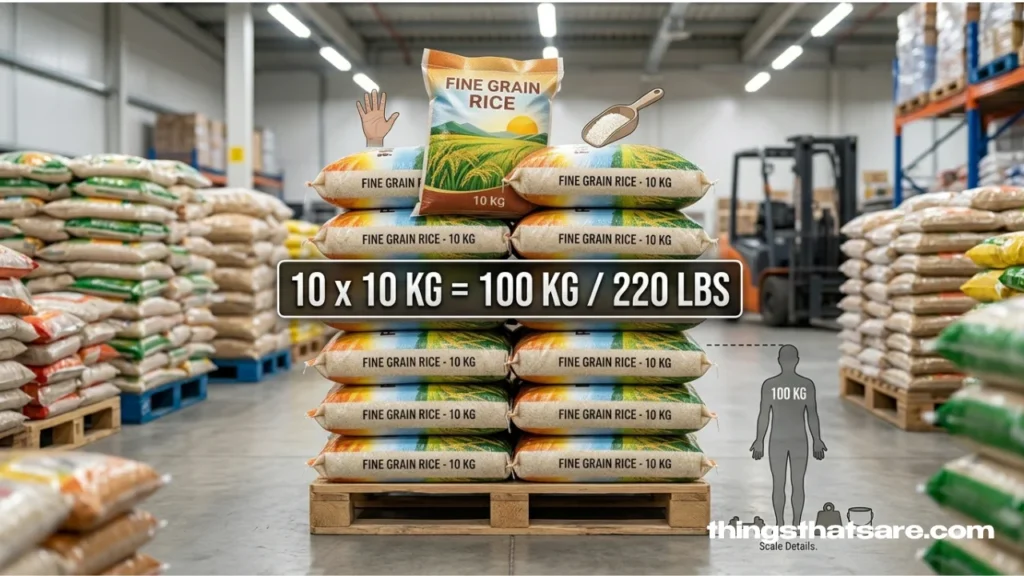
A standard retail rice bag weighs 10 kg. Line up ten of them and you’ve got exactly 100 kilograms. This is a familiar reference for restaurant owners, grocery buyers, and food distributors.
Major U.S. food distributors like Sysco and US Foods move rice in exactly this weight class. A single 100 kg rice sack is the baseline wholesale packaging unit used throughout the American food supply chain.
Newborn Elephant Calf

African elephant calves are born weighing between 100 and 150 kg — making them one of the heaviest newborns on Earth. Asian elephant calves are slightly lighter but still often reach the 100 kg range.
Remarkably, these calves can stand and walk within hours of birth. Their birth weight plays a direct role in their survival — giving them the strength to keep pace with the herd and evade predators.
Three-Seater Hardwood Sofa

A quality three-seater sofa with a hardwood frame, recliner mechanisms, and dense foam cushioning regularly hits the 95 to 110 kg range. Many flagship models land at exactly 100 kg.
This is why moving furniture always requires a plan. That sofa you’ve been sitting on every day likely weighs as much as a male gorilla — and is just as hard to move without help.
Large Home Security Safe

Premium floor-model security safes from brands like SentrySafe, Liberty Safe, and American Security weigh between 90 and 120 kg, with many flagship models landing at exactly 100 kg.
That mass comes from thick steel plate construction and heavy-duty locking bolt systems. Homeowners choose 100 kg safes deliberately — at this weight, removal without heavy equipment is nearly impossible.
Ten Sacks of Potatoes

A standard potato sack weighs approximately 10 kg depending on variety and size. Ten sacks stack up to exactly 100 kilograms — a common bulk order for restaurants and commercial kitchens.
McDonald’s processes thousands of 10 kg potato sacks daily. In wholesale agricultural markets, potatoes are routinely bought and sold in 100 kg lots, making this one of the most relatable food-based weight comparisons.
Upright Piano
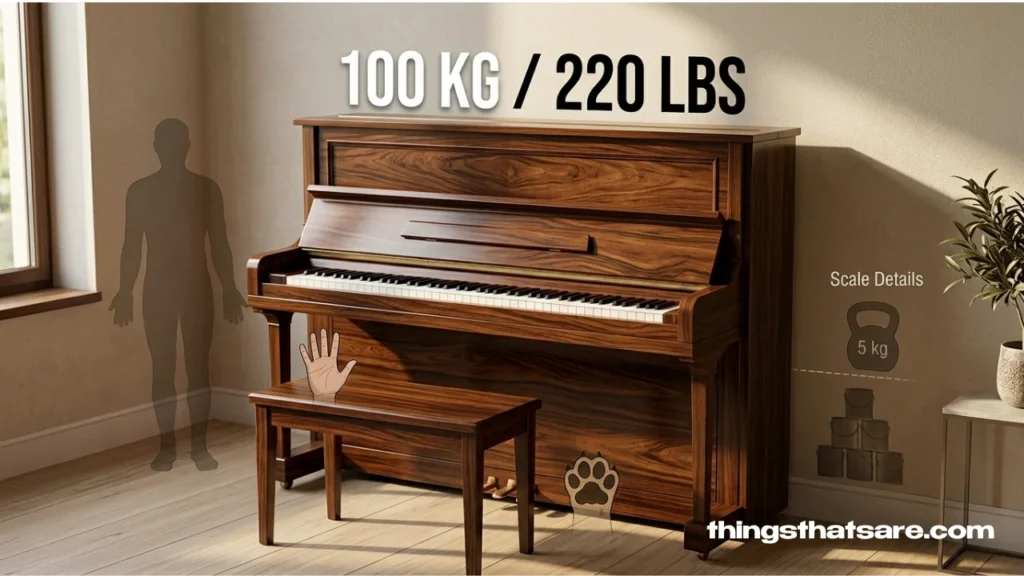
Most upright pianos weigh between 90 and 135 kg, with mid-sized models sitting right at the 100 kg mark. This is why professional piano movers never work alone.
The weight comes from the cast iron harp (or plate) inside, hardwood casing, and the dense felt-and-wire string assembly. Even compact studio uprights rarely fall below 80 kg.
Heavyweight Boxer

Under WBC, WBA, IBF, and WBO unified rules, the heavyweight division starts at 200 lbs (90.7 kg). Many elite fighters compete between 100 and 110 kg during championship bouts.
Athletes like Anthony Joshua, Oleksandr Usyk, and Tyson Fury have all competed at weights very close to 100 kg. These athletes represent what 100 kg of peak human conditioning actually looks like in motion.
Commercial Pig at Market Weight

In commercial pig farming, 100 kg is the industry benchmark for market-ready weight. Most commercial pigs raised for meat production reach this target at approximately 5 to 6 months old.
Agricultural workers and livestock farmers use the 100 kg mark as the standard harvest trigger. This benchmark is recognized across USDA grading systems and global pork export markets.
100 kg Weight Comparison Table – All 15 Examples at a Glance
Use this master reference table to compare all 15 things that weigh 100 kilograms side by side.
| Item | kg | lbs | Category |
| Adult Male Lion (adolescent) | ~100 | ~220 | Animal Kingdom |
| Standard Full-Size Refrigerator | 90–110 | 198–242 | Home Appliance |
| Front-Loading Washing Machine | 95–105 | 209–231 | Home Appliance |
| Olympic Barbell + Weight Plates | 100 | 220.46 | Fitness / Gym |
| Four 25 kg Cement Bags | 100 | 220.46 | Construction |
| Small Motorcycle / 250cc Scooter | ~100 | ~220 | Vehicle |
| Adult Male Gorilla (young) | ~100 | ~220 | Animal Kingdom |
| Ten 10 kg Rice Bags | 100 | 220.46 | Food / Agriculture |
| Newborn African Elephant Calf | 100–150 | 220–330 | Animal Kingdom |
| Three-Seater Hardwood Sofa | 95–110 | 209–242 | Furniture |
| Large Home Security Safe | 90–120 | 198–264 | Household |
| Ten 10 kg Potato Sacks | 100 | 220.46 | Food / Agriculture |
| Mid-Size Upright Piano | ~100 | ~220 | Musical Instrument |
| Elite Heavyweight Boxer | 100–110 | 220–242 | Sports / Athletics |
| Commercial Pig (market weight) | ~100 | ~220 | Agriculture |
Is 100 kg a Healthy Body Weight? (What Experts Say)
This is one of the most searched questions around this topic — and the answer isn’t a simple yes or no. Whether 100 kg is healthy depends entirely on your height, age, sex, and body composition.
Is 100 kg Overweight? BMI, Height & Age Breakdown
Body Mass Index (BMI) is the standard screening tool used by the CDC, WHO, and most healthcare providers. For a person who is 5’10” (178 cm), a weight of 100 kg gives a BMI of approximately 32.3 — which falls in the ‘obese’ category.
However, BMI does not account for muscle mass. A heavyweight boxer at 100 kg has a high BMI but extremely low body fat. This is why physicians use BMI alongside waist circumference, body fat percentage, and metabolic health markers for a complete picture.
Is 5’11” and 100 kg Overweight?
At 5’11” (180 cm) and 100 kg, your BMI is approximately 30.9 — technically at the lower threshold of the ‘obese’ range (BMI ≥ 30).
That said, many athletic individuals at this height and weight carry high muscle mass and have excellent metabolic health. A doctor’s assessment — not a BMI chart alone — should guide any health decision.
What Is a Normal Healthy Weight by Age?
The CDC provides the following average weight ranges for adult Americans by age group:
| Age Group | Average Weight (Men) | Average Weight (Women) |
| 20–39 years | ~196 lbs (89 kg) | ~167 lbs (76 kg) |
| 40–59 years | ~200 lbs (91 kg) | ~176 lbs (80 kg) |
| 60+ years | ~194 lbs (88 kg) | ~166 lbs (75 kg) |
These are population averages, not ideal targets. Healthy weight varies significantly by individual height, frame size, and muscle composition.
How Many kg Is Considered a Healthy Weight?
According to the WHO, a healthy BMI ranges from 18.5 to 24.9. For an average adult male standing 5’10” (178 cm), a healthy weight range would be approximately 58 to 78 kg (128 to 172 lbs).
For someone taller — say, 6’2″ (188 cm) — a healthy weight climbs to 72 to 97 kg. At this height, 100 kg sits very close to the upper edge of the healthy range.
Frequently Asked Questions About 100 Kilograms
What weighs 100 kilograms?
Many everyday objects weigh approximately 100 kilograms. These include a standard full-size refrigerator, a front-loading washing machine, an Olympic barbell loaded with weight plates, four 25 kg cement bags, a small motorcycle, a mid-size upright piano, a large home security safe, ten 10 kg bags of rice, and a heavyweight boxer or adolescent male lion.
What is 100 kilograms in weight?
100 kilograms equals 220.46 pounds, 15.75 stone, 100,000 grams, and 0.1 metric tons. On Earth, it exerts a gravitational force of approximately 980.7 Newtons. In trade and agriculture, it is sometimes referred to as one metric quintal.
What is a weight of 100 kilograms called?
In trade and agricultural contexts, 100 kilograms is called a metric quintal (or quintal). This term is widely used in commodity markets, bulk food trade, and agricultural export systems worldwide.
Is 100 kg a good weight?
It depends entirely on your height and body composition. For a very tall, muscular individual, 100 kg can be a healthy, athletic weight. For someone shorter, it may fall into an overweight or obese BMI range. Always consult a healthcare professional rather than relying on BMI alone.
Is 5’11 / 100 kg overweight?
At 5’11” (180 cm) and 100 kg, your BMI is approximately 30.9, which sits at the lower threshold of the obese range. However, if you carry significant muscle mass — as many athletes at this size do — your actual health risk may be much lower than the BMI number suggests.
How many kg is a healthy weight?
According to the WHO, a healthy BMI falls between 18.5 and 24.9. For most adult men in the USA (average height 5’9″), a healthy weight sits between approximately 56 and 79 kg (123 to 174 lbs). The healthy weight range increases with height.
What is normal weight by age?
The CDC reports that American men aged 20–39 average around 196 lbs (89 kg), those aged 40–59 average around 200 lbs (91 kg), and men 60+ average around 194 lbs (88 kg). For women, averages are lower: roughly 167 lbs (76 kg) for ages 20–39. These figures are population averages — not prescriptions.
Can a person weigh 200 kg?
Yes. Although extremely rare, some individuals weigh 200 kg (440 lbs) or more. This level of body weight is classified as severe or morbid obesity and carries serious health risks, including cardiovascular disease, type 2 diabetes, and joint deterioration. Medical intervention is typically recommended at this weight range.
Is 80 kg big for a man?
Not necessarily. At 80 kg (176 lbs), most men of average height (5’9″ to 5’11”) fall within a healthy or slightly overweight BMI range. For taller men (over 6′), 80 kg is comfortably within the healthy weight zone. Athletic men often maintain 80–90 kg with high muscle mass and low body fat.
Conclusion
100 kilograms is not just a number. It’s the refrigerator in your kitchen, the lion at the zoo, the barbell in your gym, and the cement bags on a job site.
Whether you’re tracking fitness goals, planning a move, shipping cargo, or just satisfying your curiosity — these Things that weigh 100 KG 15 real-world examples give you the mental anchors you need. Next time someone mentions 100 kg, you won’t need to guess. You’ll already know exactly what that weight feels like.