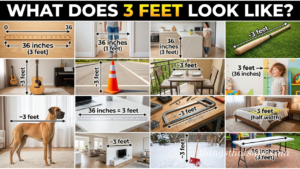
Ever tried to picture how long 40 feet really is? Most people can’t. It’s one of those measurements that sounds big — but feels abstract until you connect it to something real.
That’s exactly what this guide does. From ocean giants to everyday vehicles, these 15 real-world examples make 40 feet instantly visual, relatable, and unforgettable.
How Long Is 40 Feet, Really?
40 feet equals 12.19 meters, 480 inches, or 13.33 yards. In miles, it’s just 0.0076. In centimeters, it stretches to 1,219.2 cm.
But numbers alone don’t paint the picture. Here’s what actually helps:
- 8 average adults lying head to toe = roughly 40 feet
- Walking speed: it takes about 13–15 seconds to cross 40 feet at a normal pace
- Two compact cars parked bumper-to-bumper = approximately 40 feet
- It’s 4 times the length of a standard 10-foot room
| Unit | Equivalent |
|---|---|
| Inches | 480 in |
| Yards | 13.33 yd |
| Meters | 12.19 m |
| Centimeters | 1,219.2 cm |
| Kilometers | 0.012 km |
| Miles | 0.0076 mi |
Most people walk past 40-foot objects every single day without realizing it and seeing their size comparison. The section below will change how you see them.
Must Visit: 15 Things That Measure 30 Feet Long or Are Big 2026
15 Things That Are 40 Feet Long or Big
Standard 40-Foot Shipping Container

The standard ISO shipping container is exactly 40 feet long, 8 feet wide, and 8.5 feet tall. It’s the most universally recognized 40-foot object on Earth.
These steel boxes — built from Cor-ten weathering steel — carry roughly 30,000 kg of cargo across oceans, railways, and highways. According to the World Shipping Council, around 800 million container ship movements happen globally each year.
The interior measures 39’5″ long × 7’7″ wide × 7’9″ high, with a usable volume of approximately 67 cubic meters. They hold up to 21 American pallets or 25 Euro pallets in a single load.
Why it matters: Every product you order online has likely traveled inside one of these.
Must visit: 17 Things That Are 50 Feet Long (Will Surprise You)
Standard School Bus (Type C)

A full-size Type C school bus stretches 35 to 40 feet long — the most common bus size on American roads. It transports roughly 80 passengers and is one of the most familiar 40-foot vehicles in the USA.
The iconic yellow color isn’t just tradition. According to the National Highway Traffic Safety Administration (NHTSA), school buses are the safest form of road transportation for children — partly because of their size and structure.
Standing beside one gives you an immediate, no-tools-needed reference for what 40 feet looks like in real life.
Semi-Truck Trailer

Standard semi-truck trailers — the ones hauling goods across America’s interstates — commonly measure 40 feet long. The U.S. Department of Transportation allows up to 48-foot trailers on federal highways, but 40-foot trailers remain a core industry standard.
These intermodal freight giants carry up to 36,000 kg gross weight and form the backbone of the American supply chain logistics network. If you’ve ever been passed by one on I-95, you’ve seen 40 feet moving at 70 mph.
Whale Shark (Rhincodon typus)
The whale shark is the largest fish on the planet — and fully grown specimens reach up to 40 feet (12 meters) in length, weighing up to 20 metric tons.
Despite their size, they’re gentle filter feeders, surviving mainly on plankton and small fish. They’re commonly spotted in warm tropical waters near the Philippines, Mexico, Maldives, and Belize.
Imagine swimming next to one. That’s 40 feet of living, breathing ocean biology gliding silently beside you.
Four-Story Building

Commercial buildings average 10 feet per floor. A four-story structure therefore stands approximately 40 feet tall — one of the most common building heights in American urban architecture.
Office complexes, apartment buildings, boutique hotels, and mixed-use developments regularly use this height. It sits in a zoning sweet spot — tall enough to maximize space, short enough to avoid complex high-rise regulations in most U.S. cities.
How tall is a 3-story house? A standard 3-story residential home stands roughly 30–35 feet tall, making 40 feet noticeably taller by comparison.
Class A Motorhome / Luxury RV
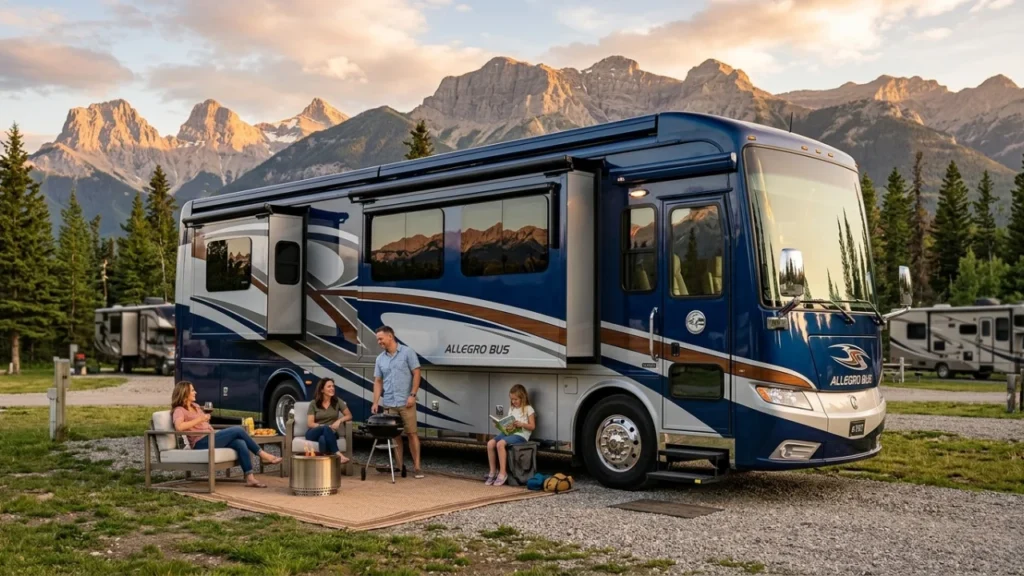
Premium Class A motorhomes — the kind you see parked at national park campgrounds — commonly measure 38 to 45 feet long, with 40 feet being a flagship size.
At 40 feet, these rolling homes include full kitchens, master bedrooms, multiple slide-outs, and sometimes even washer/dryer units. They require dedicated 40-foot RV-rated campsites and are priced between $150,000 to over $1 million for luxury models.
This is 40 feet of genuine, road-legal living space.
40-Foot Extension Ladder

A 40-foot extension ladder is standard equipment for firefighters, contractors, and utility crews working on four-story structures and tall trees.
Professional aluminum extension ladders at this length are rated for 250–375 lbs load capacity depending on duty grade. OSHA mandates fall protection for workers at heights exceeding just 4 feet in general industry — making a 40-foot ladder a serious, high-consequence piece of equipment.
Laying one flat on the ground is one of the clearest physical ways to grasp what 40 feet looks like horizontally.
Light Pole / Telephone Pole
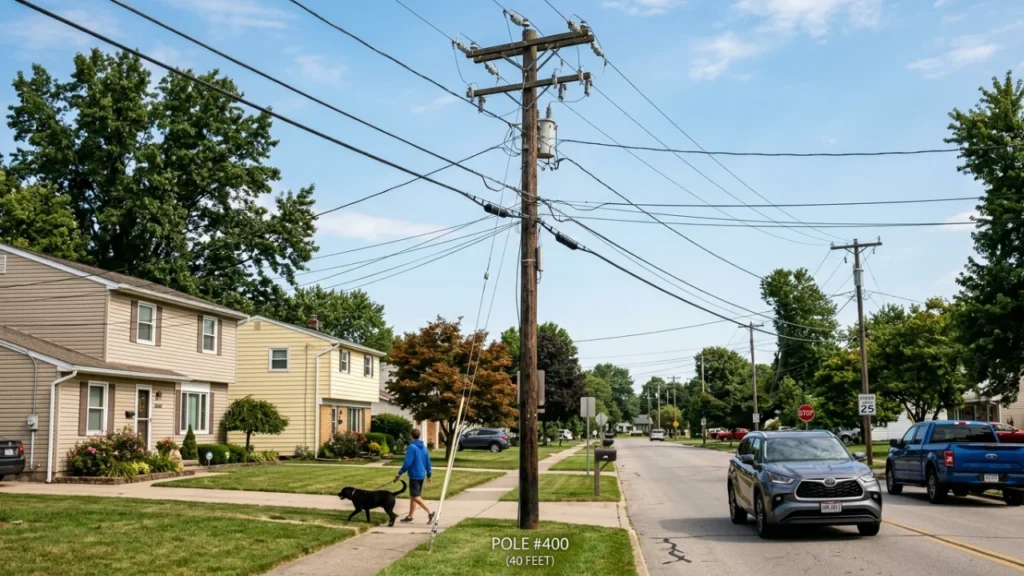
Standard utility poles and street light poles in the USA typically stand 30 to 40 feet tall. The Florida Public Service Commission lists the average exposed height at 36 feet, with taller installations reaching exactly 40 feet.
Most are made from pressure-treated pine and have a lifespan of 25 to 50 years depending on climate and preservatives. They carry power lines, cable, fiber optic, and communication infrastructure across every city and suburb in America.
The next time you drive down any American street — look up. 40 feet is staring back at you.
40-Foot Sailboat / Mid-Size Yacht

In the boating world, 40 feet is a serious milestone. A 40-foot sailing vessel or motor yacht is considered a full-capability offshore cruiser — equipped for open-ocean passage-making with proper navigation, sleeping quarters, and galley.
Marinas charge premium slip rates for 40-foot boats, and this size requires a captain’s license or equivalent experience to handle safely in open water. Popular manufacturers like Beneteau, Jeanneau, and Hunter offer flagship 40-foot models.
It’s 40 feet of fiberglass, rigging, and serious maritime capability.
Half the Length of a Tennis Court

A standard tennis court measures 78 feet long. Half of that — 39 feet — is just shy of 40 feet, making it one of the most useful sports-based references for this measurement.
The USTA (United States Tennis Association) specifies court dimensions strictly for competitive play. So next time you watch a match, picture the baseline to the net and then slightly beyond — that’s your 40-foot reference, right on the court.
Two Full-Size SUVs End-to-End

A Chevrolet Suburban — one of America’s largest production SUVs — measures approximately 18.8 feet long. Park two of them bumper-to-bumper and you’re looking at roughly 37–40 feet, depending on the model year.
This is one of the most practical parking lot visualizations for 40 feet. No tape measure needed — just picture two Suburbans in a line.
Brachiosaurus (Neck Fully Extended)

Here’s the one most people don’t see coming. A Brachiosaurus — one of the tallest dinosaurs ever documented — stood approximately 43 feet tall with its neck fully extended.
A life-size resin cast of the original specimen is on permanent display at O’Hare International Airport in Chicago. That means 40 feet is just slightly shorter than a prehistoric giant that roamed Earth 150 million years ago.
Scale doesn’t get more dramatic than that.
Three Volkswagen Beetles Lined Up
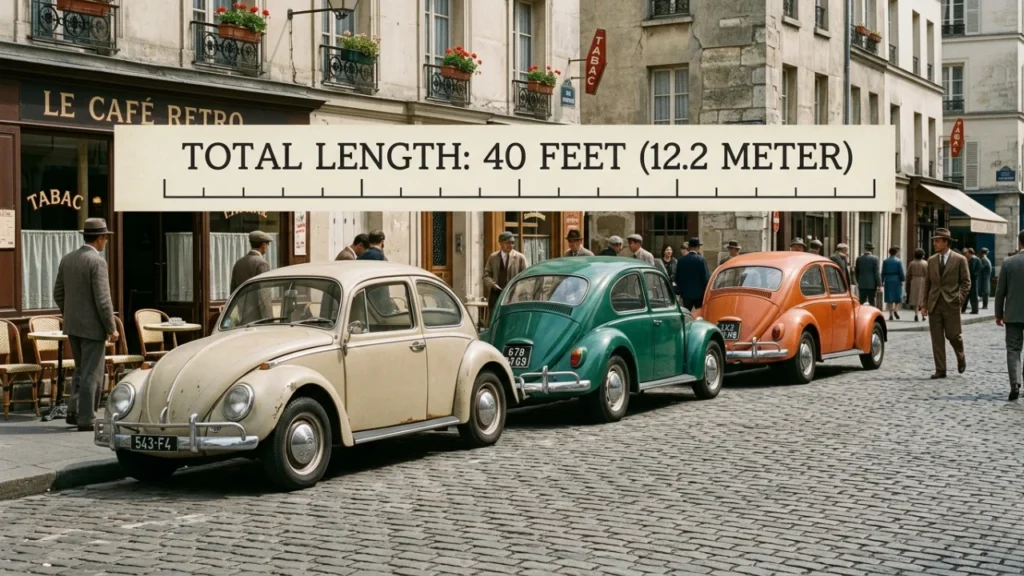
A classic 1964 Volkswagen Beetle measures 13.38 feet long. Line up three of them bumper-to-bumper and you get approximately 40 feet — almost exactly.
The Beetle holds the record as the longest continuously-produced automobile design, built for 65 years from 1938 to 2003. It was also voted the 4th most influential car of the 20th century by the Global Automotive Elections Foundation.
Three icons of automotive history = one 40-foot reference point.
A Regulation Bowling Lane (⅔ Reference)
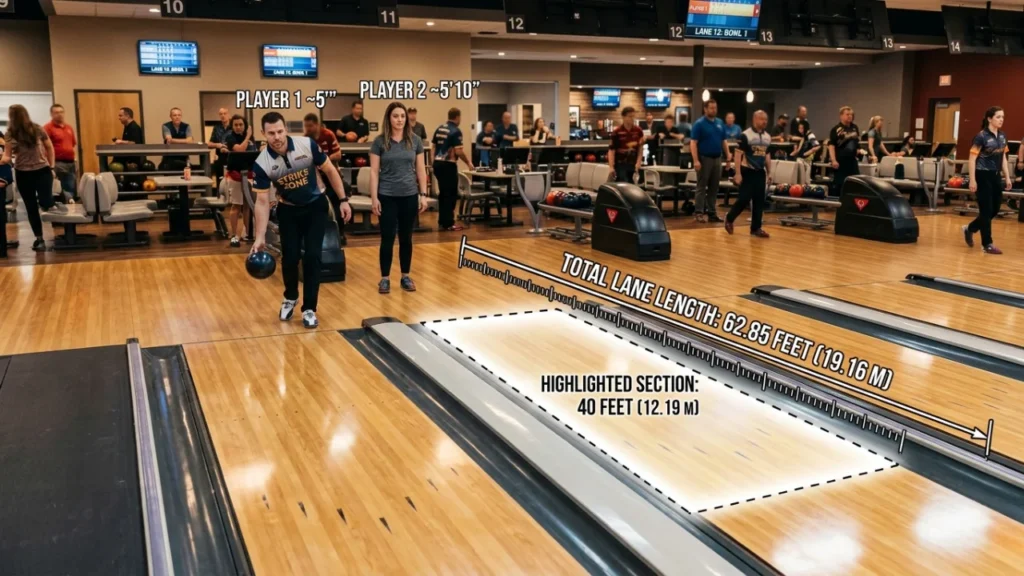
A USBC-regulation tenpin bowling lane measures 62.85 feet from foul line to head pin. That means 40 feet covers roughly ⅔ of a full bowling lane — from the foul line well past the arrows and deep into the approach zone toward the pins.
Bowlers and fans who know their sport can immediately use this as a sharp mental calibration tool for visualizing 40 feet indoors.
Red Maple & English Oak Tree

In nature, 40 feet marks an important growth milestone for two iconic trees.
The Red Maple (Acer rubrum) — one of North America’s most widespread species — typically reaches 40 to 60 feet at maturity, painting entire forests in brilliant crimson each autumn.
Across the Atlantic, the English Oak (Quercus robur) — a cultural symbol of endurance in Britain and Western Europe — begins its mature phase at around 40 to 50 feet, eventually reaching 75 to 100+ feet in ancient woodlands.
Both trees show that 40 feet is where nature starts to feel genuinely grand.
How High Is 40 Feet in the Air?
40 feet in the air is no joke. It’s the height of a four-story building — high enough to require specialized equipment to reach safely.
Here’s what puts it in perspective:
- OSHA mandates fall protection at just 4 feet in general industry settings. 40 feet is 10 times that threshold.
- Firefighters deploy 40-foot aerial ladders as standard first-response equipment for residential and low-rise commercial buildings.
- Aircraft hangars and warehouses commonly use 40-foot interior clearances to accommodate large equipment.
- Looking up at 40 feet feels drastically different from lying down with the same distance stretched out in front of you — this is called vertical perception distortion, and it’s why heights feel more intense than horizontal distances.
Where You See 40 Feet in Everyday American Life
This is what competitors completely miss. 40 feet isn’t just a measurement — it’s woven into the fabric of daily American life.
- American driveways average 18–20 feet. Two driveways end-to-end = 40 feet.
- The NFL’s famous “40-yard dash” — the gold standard speed test at the Combine — is 120 feet long. One-third of that iconic sprint equals 40 feet.
- Lap pools for competitive training are standardized at 40 feet (short course) in many American fitness facilities.
- Residential zoning setbacks in many U.S. municipalities reference 40-foot lot frontages as a standard measurement.
- Commercial garage bays in auto dealerships and service centers often span 40 feet in bay length to accommodate large trucks and RVs.
- An Interstate highway lane is 12 feet wide. Lay three of them side by side — that’s 36 feet. Add the shoulder and you’re at 40 feet.
40 feet is everywhere. You just never had a name for it before.
Frequently Asked Questions About 40 Feet
What is 40 feet comparable to?
40 feet is comparable to a standard shipping container, a full-size school bus, a semi-truck trailer, or a whale shark. It also equals two full-size SUVs parked end-to-end, or roughly eight average adults lying head to toe.
How much is 40 ft in length?
40 feet equals 12.19 meters, 480 inches, 13.33 yards, 1,219.2 centimeters, and 0.0076 miles. Walking it at a normal pace takes about 13–15 seconds.
How many stories is a 40 ft tall building?
A 40-foot tall building equals approximately 4 stories, based on the standard commercial floor height of 10 feet per story. Residential floors with taller ceilings may result in only 3 stories at 40 feet.
How big is a 40 ft home?
A 40-foot home typically refers to length. A 40 ft × 20 ft home = 800 square feet, which is a compact but livable single-family footprint. A 40 ft × 40 ft home = 1,600 square feet — a comfortable mid-size American home. Many container homes built from 40-foot shipping containers offer approximately 320 square feet of interior living space per container.
What building is 40 feet?
A standard four-story commercial or residential building stands at approximately 40 feet. This includes many apartment complexes, office buildings, boutique hotels, and mixed-use structures across American cities.
How tall is a 3-story house?
A standard 3-story house stands roughly 30 to 35 feet tall, with each residential floor averaging 10 to 11.5 feet in total height including structure. This makes a 3-story house noticeably shorter than the 40-foot mark.
Final Thoughts
40 feet shows up everywhere — in the ocean, on highways, in your neighborhood, and deep in natural history. Most people walk past 40-foot objects daily without a second thought.
Now you have 15 concrete, visual anchors that make this measurement real. Whether you’re planning a move, evaluating a property, shopping for a container, or just satisfying your curiosity — you’ll never look at a school bus, a shipping container, or a tall tree the same way again.
40 feet isn’t just a number. It’s a measure of the world around you.