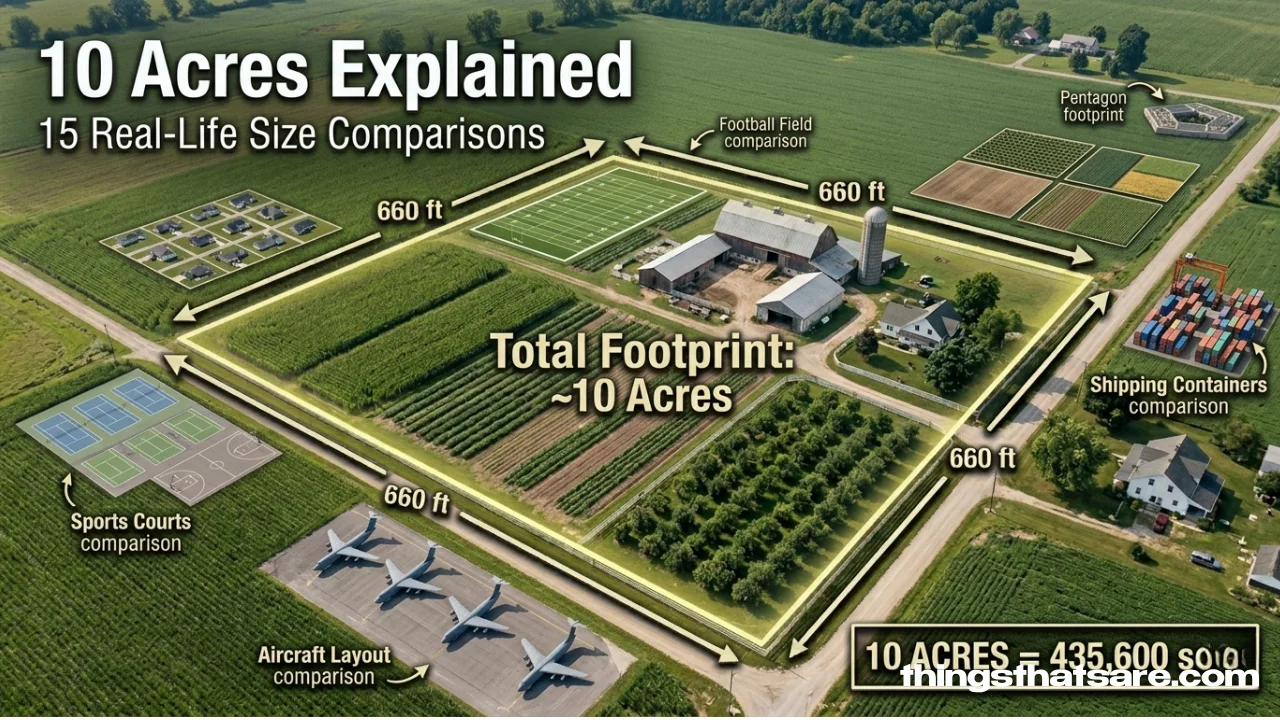
Things That Measure 10 Acres. Most people have no idea how big 10 acres of land actually is. That’s completely normal. Acres are abstract — you can’t hold one in your hand or park one in your driveway.
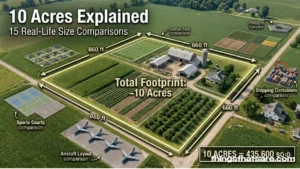
But here’s the truth: 10 acres equals 435,600 square feet. That number still doesn’t help most people picture it. So we did the work for you. Below are 15 real-life comparisons that make the size of 10 acres instantly clear — no math degree required.
What Is 10 Acres? Quick Facts First
According to Merriam-Webster, an acre is a unit of area equal to 43,560 square feet or 4,047 square meters. So, 10 acres = 10 × 43,560 = 435,600 square feet.
Here’s how 10 acres stacks up in different units:
- 435,600 square feet
- 48,400 square yards
- 4.05 hectares
- 0.015625 square miles
- About 1/64th of a square mile (which holds 640 acres total)
The USDA Agricultural Handbook No. 697 — a trusted federal reference for weights and land measures — confirms these conversion factors for agricultural land use.
A square 10-acre plot would measure roughly 660 feet on each side. If you stood at one corner and walked to the other, that’s about a 2-minute walk at a normal pace.
Things That Measure 10 Acres: 15 Real-Life Size Comparisons
These comparisons are grounded in real measurements, verified locations, and satellite-confirmed land areas.
1. About 7.5 American Football Fields
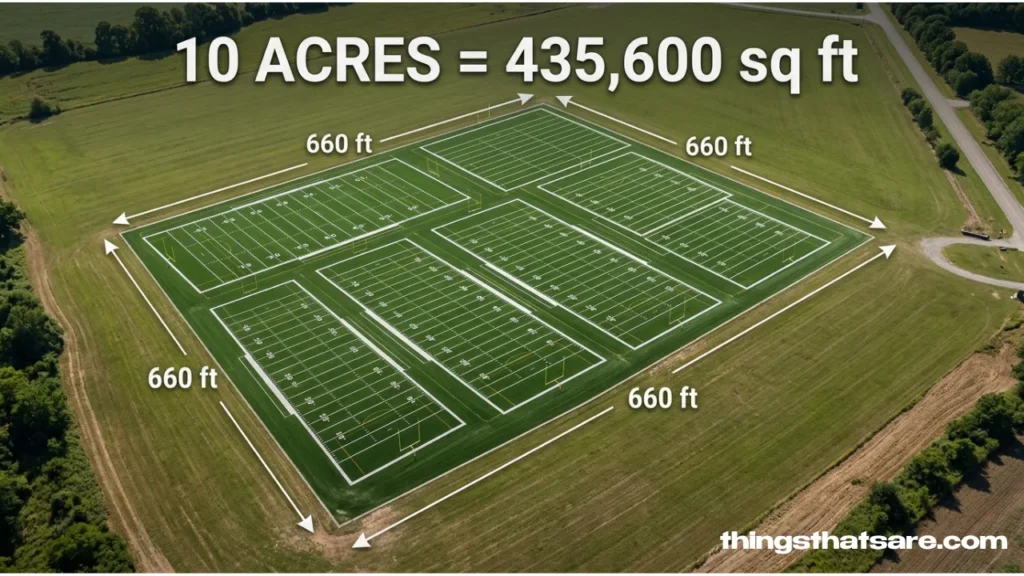
An American football field — end zone to end zone — measures 360 × 160 feet, which equals 1.32 acres. Multiply that out and 10 acres fits roughly 7.5 football fields.
If you stood at one corner of a 10-acre square plot, the boundary stretches 3 full football fields in each direction. That’s the clearest mental picture most Americans can grab.
2. The Pentagon (Washington, D.C.)

The Pentagon — the U.S. Department of Defense headquarters in Arlington, Virginia — covers exactly 29 acres in total. Its famous inner courtyard alone covers about 5 acres.
That means 10 acres is roughly the size of one-third of the entire Pentagon complex. It’s one of the most recognizable land-area benchmarks in the United States.
3. Liberty Island — Home of the Statue of Liberty
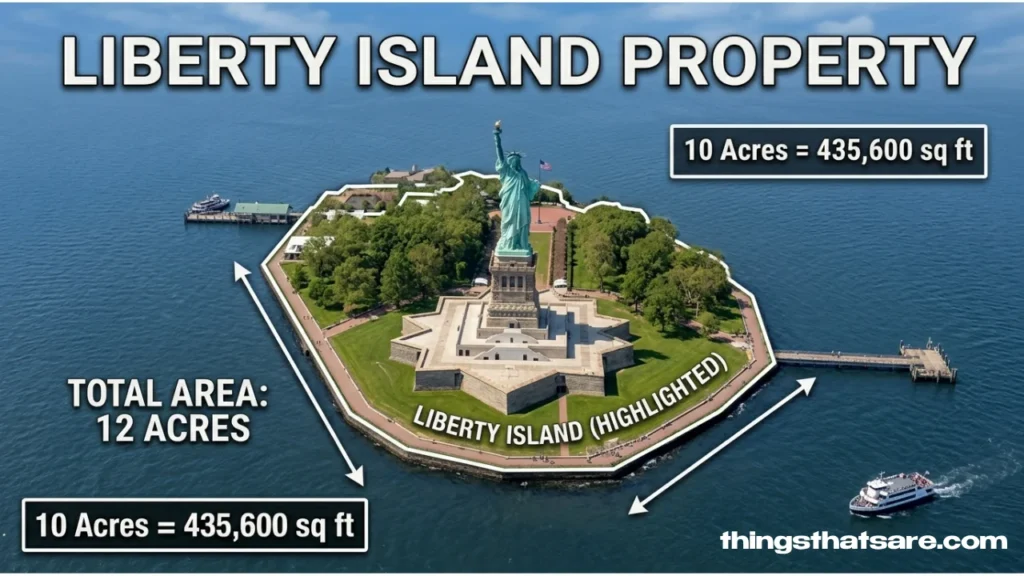
Liberty Island in New York Harbor covers approximately 14.7 acres. The area directly surrounding the Statue of Liberty and its star-shaped base — about 10 acres — gives you a perfect real-world snapshot.
GPS coordinates: 40.6892° N, 74.0445° W. You can verify this on Google Maps satellite view.
Must Visit: 15 Common Things That Are Exactly 11 Inches Long (Surprising!)
4. Ellis Island, New York
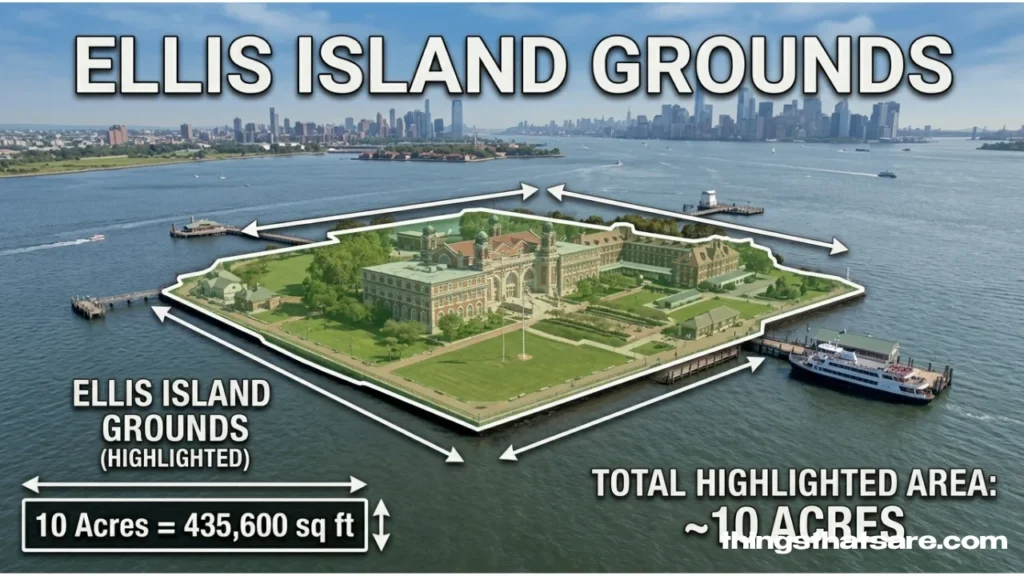
Historic Ellis Island — the famous immigration gateway in Upper New York Bay — covers close to 27.5 acres. The main building complex and its grounds span roughly 10 acres, making it another excellent real-world reference point.
5. The Fountains of Bellagio, Las Vegas
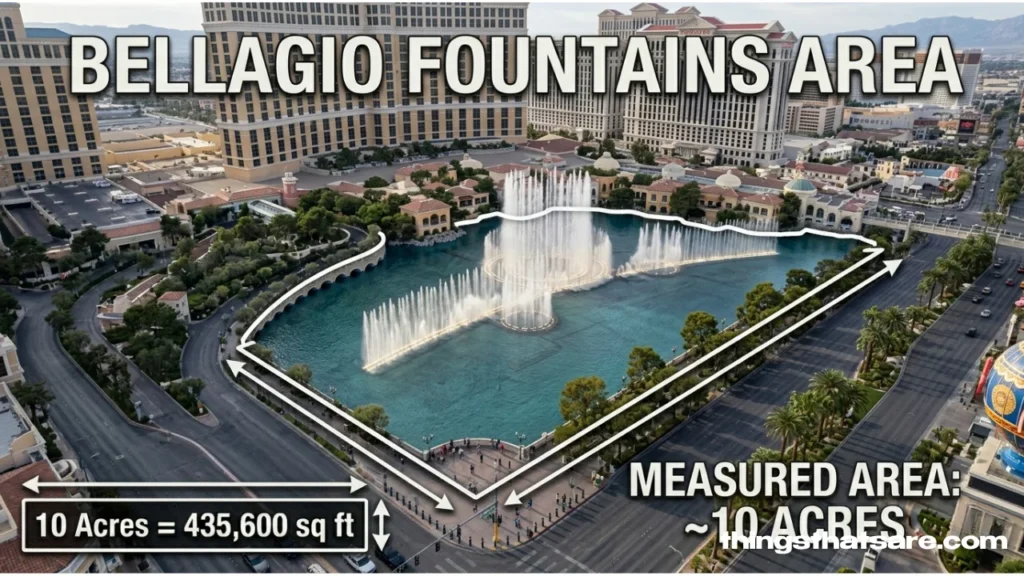
The iconic Bellagio Resort fountain lake on the Las Vegas Strip covers approximately 8.5 acres of water surface. Add the surrounding promenade and you’re looking right at 10 acres.
GPS: 36.1127° N, 115.1741° W. Pull it up on satellite view — it’s a stunning visual anchor.
6. Churchill Downs — Home of the Kentucky Derby
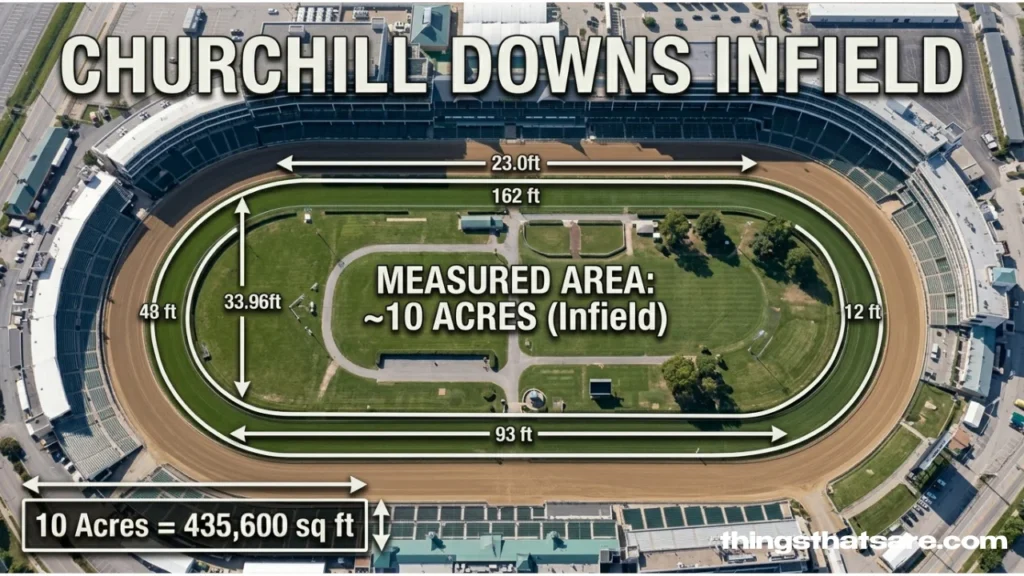
The Churchill Downs racetrack infield in Louisville, Kentucky, covers just over 10 acres. Every Kentucky Derby, over 150,000 fans pack into a venue built on this footprint. That’s 10 acres of human energy.
7. One-Tenth of Pando — The World’s Largest Living Organism
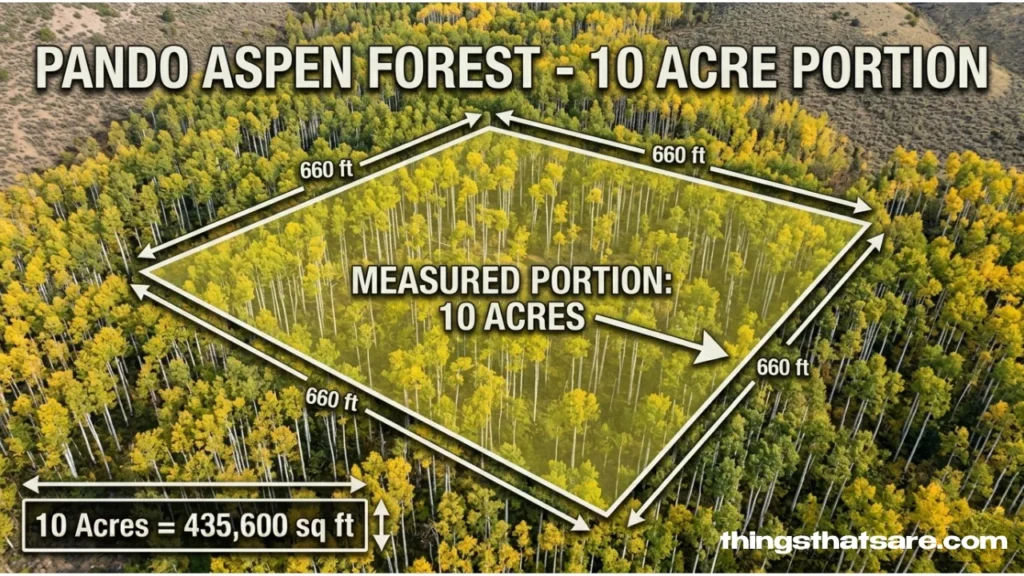
This one is something no competitor talks about — and it’s remarkable. Pando (Latin for ‘I spread’) is a massive quaking aspen clone — Populus tremuloides — located in Sevier County, Utah, inside the Fishlake National Forest. It’s the world’s largest tree by weight and landmass, spanning an estimated 106 acres with approximately 47,000 stems all connected by a single root system.
Here’s the mind-bending part: 10 acres is just one-tenth of Pando’s total mass. One tree. 106 acres. Estimated to be between 9,000 and 16,000 years old. For scale, 10 acres is a small corner of what is essentially one single, immortal organism.
Researchers from the Fishlake National Forest and Friends of Pando continue to study and protect this extraordinary living landmark.
8. Nine USAF C-5 Galaxy Aircraft Side by Side
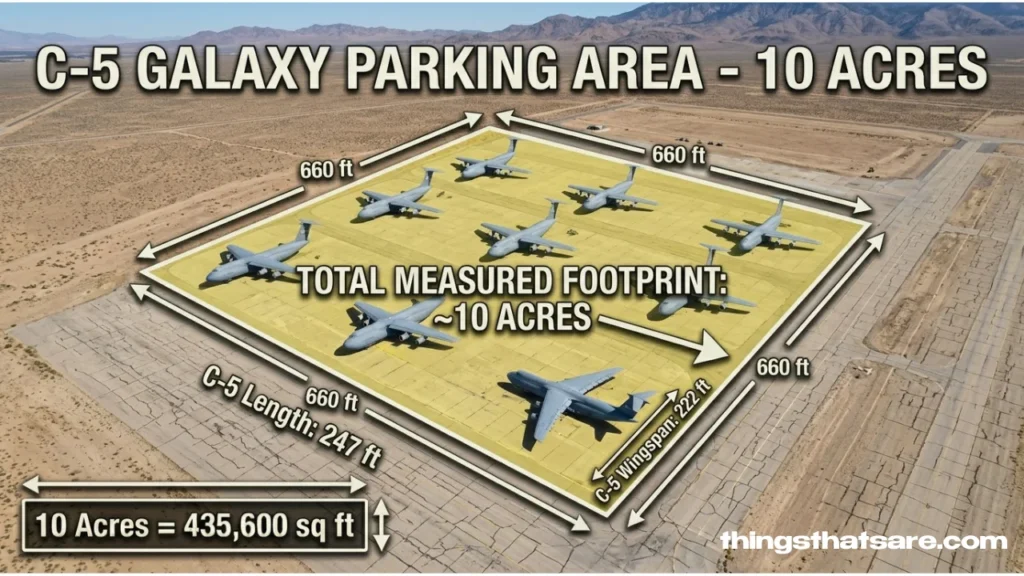
At Davis-Monthan Air Force Base in Tucson, Arizona, decommissioned aircraft are parked in rows across the desert. Nine C-5 Galaxy cargo aircraft — each measuring 247 feet long with a 222-foot wingspan — occupy approximately 10 acres of tarmac. GPS: 32.1499° N, 110.8359° W.
9. 155 Tennis Courts
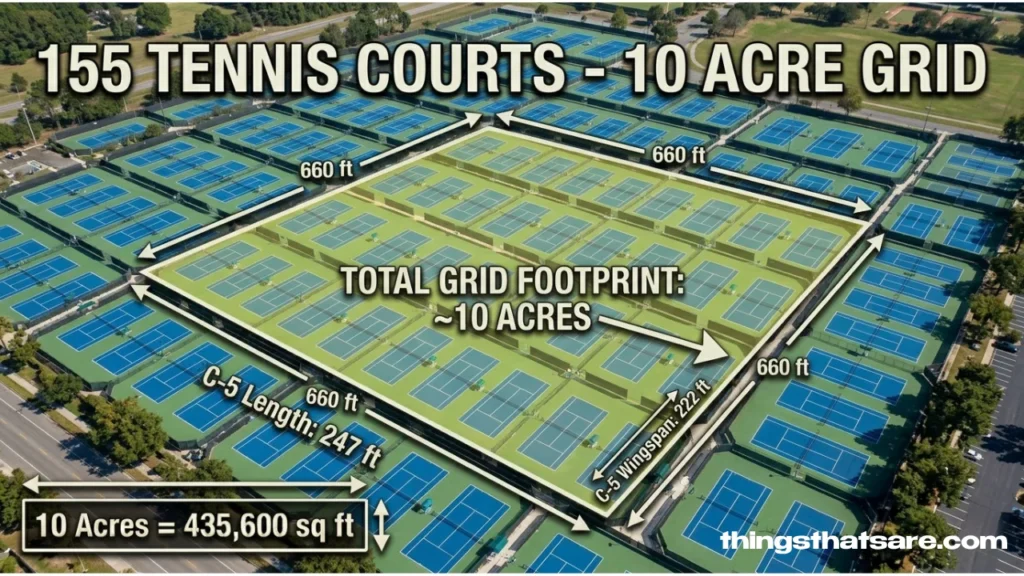
A standard tennis court measures 78 × 36 feet — about 2,808 square feet. Pack 155 of them together and you hit 435,240 square feet, which is essentially 10 acres.
The largest tennis facility in the U.S. — the USTA Billie Jean King National Tennis Center in Flushing Meadows, New York — has 22 courts. You’d need seven facilities that size to fill 10 acres.
10. 90 NBA Basketball Courts
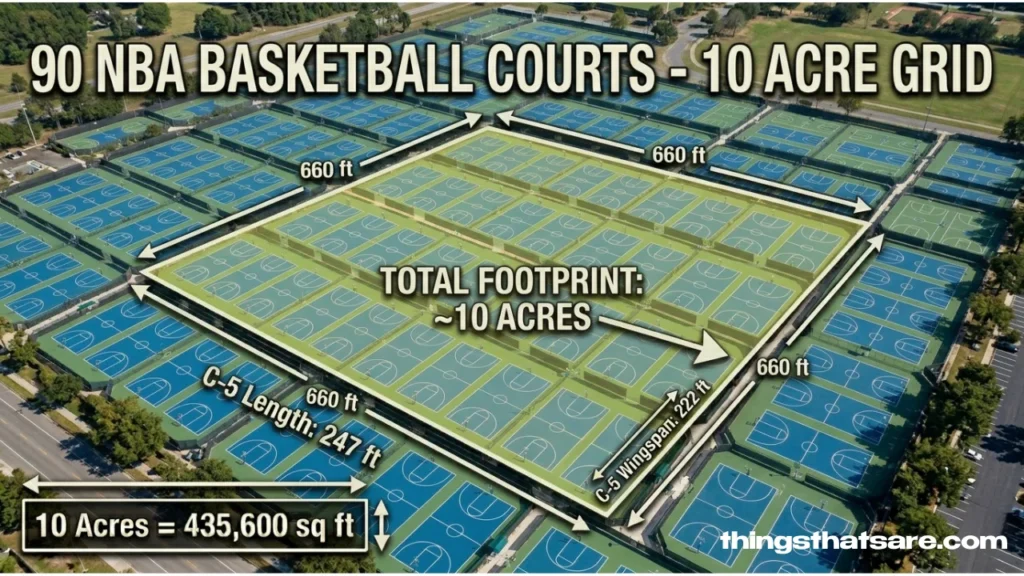
An NBA basketball court is 94 × 50 feet = 4,700 square feet. Line up 90 of them and you have 423,000 square feet — just under 10 acres. Add a little surrounding space and you’re right there.
11. 192 Median-Sized American Homes
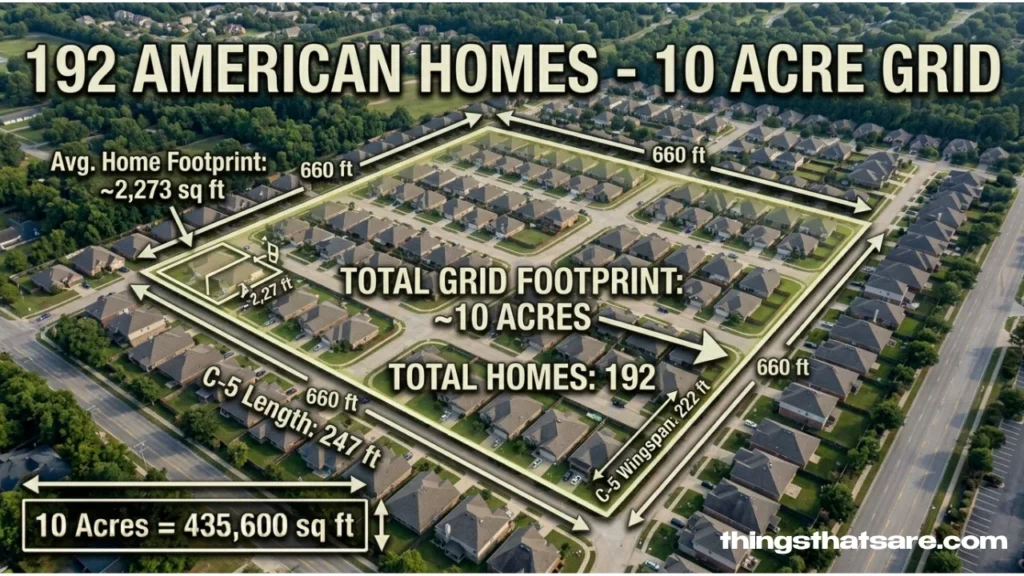
The median American home size in 2024 sits at around 2,273 square feet, according to U.S. Census Bureau data. Fit 192 of those homes together — no yards, no driveways — and you’ve got roughly 10 acres of living space.
12. 1,560 Standard Parking Spaces
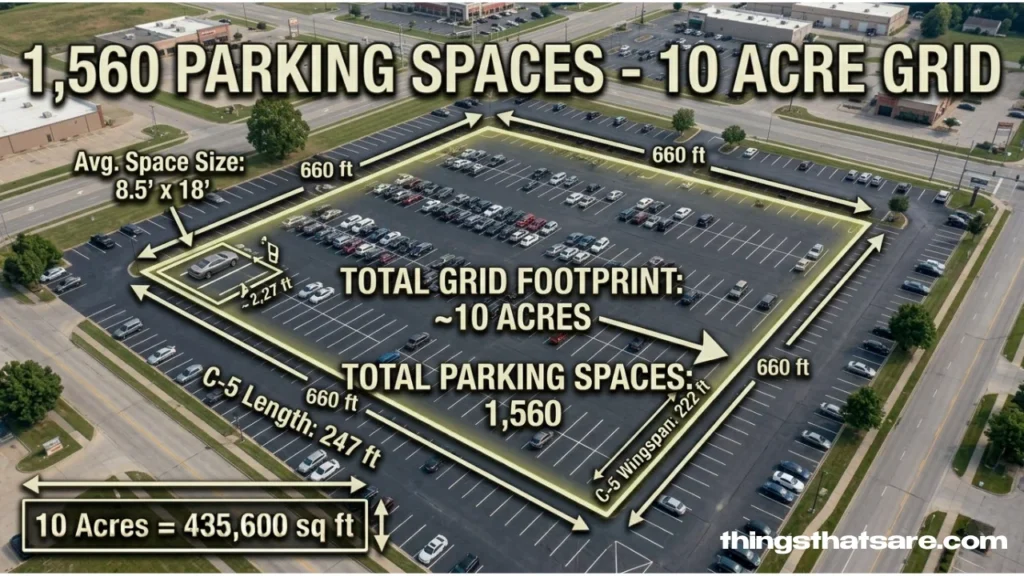
A standard parking space in the U.S. is typically 8.5 × 18 feet = 153 square feet. Squeeze in 1,560 of them and you land at just over 435,000 square feet — 10 acres flat.
Think about the last massive mall parking lot you drove through. That’s the scale we’re talking about.
13. A Typical Small Suburban Neighborhood Block
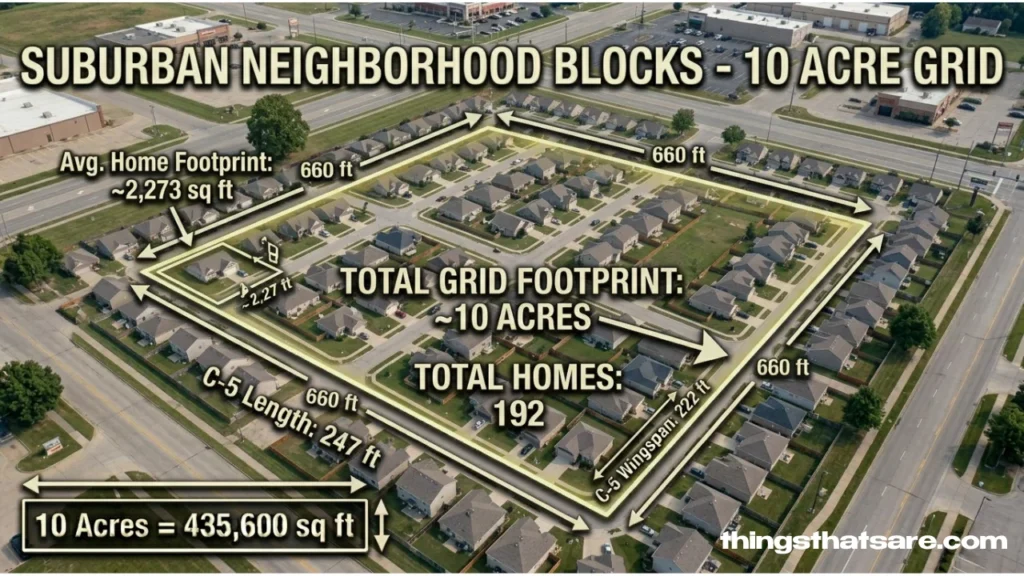
In most U.S. suburban areas, a standard city block covers between 2 to 5 acres. A 10-acre parcel would contain two to three full neighborhood blocks — homes, sidewalks, driveways included.
Drive slowly through your neighborhood. Count two or three full blocks. That’s what 10 acres looks like on the ground.
14. Shipping Container Yard at the Port of Long Beach
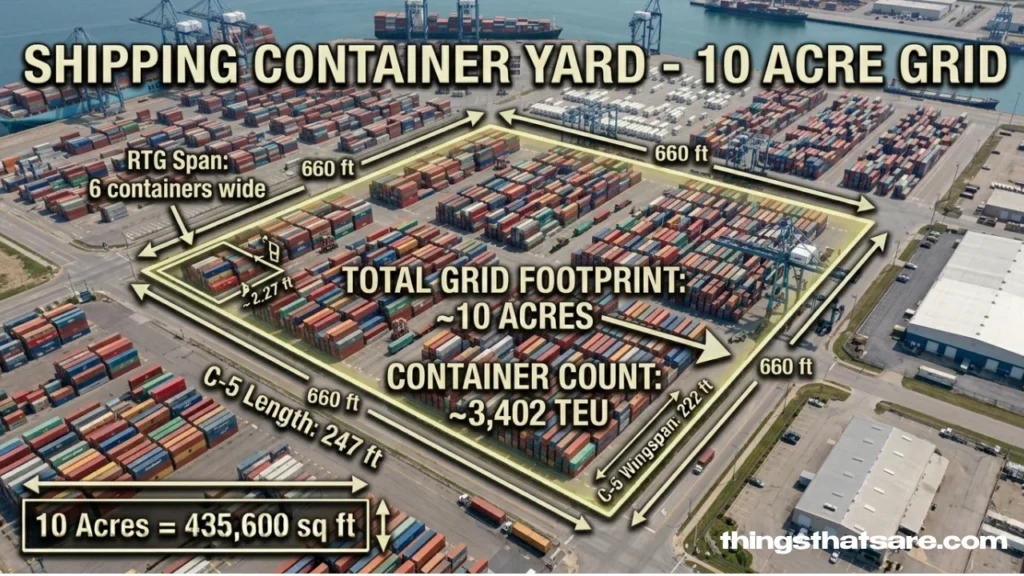
At the Port of Long Beach, California — one of the busiest ports in North America — a standard 20-foot shipping container occupies about 320 square feet. Stack 1,361 of them flat and you’ve covered 10 acres.
GPS: 33.7285° N, 118.2544° W. The satellite view shows stacked containers across a space that feels endless — that’s your 10 acres.
15. A Productive Small Farm — Ten Acres Enough
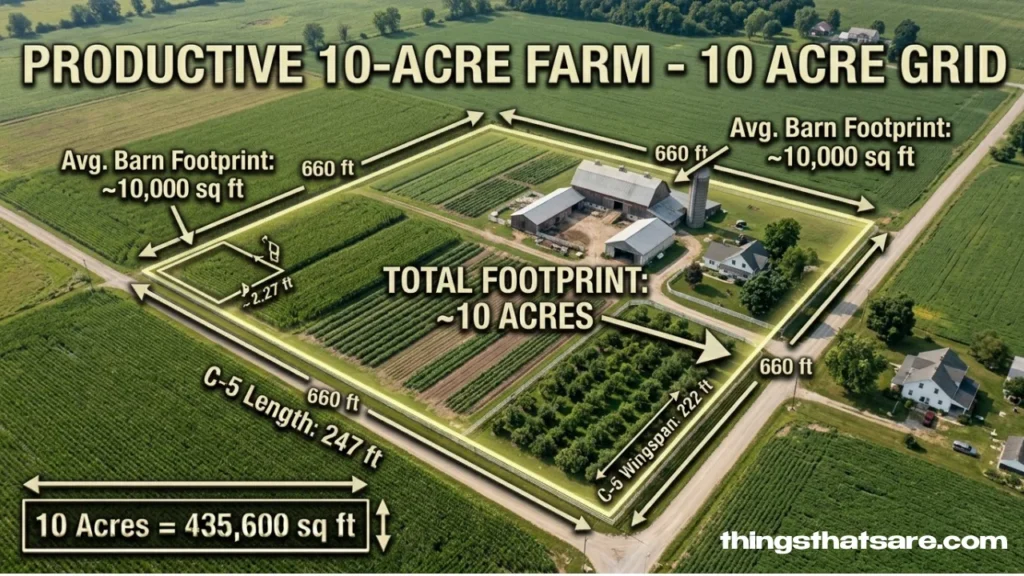
In 1864, a Philadelphia businessman named Edmund Morris wrote “Ten Acres Enough” — a now-classic farming book published by James Miller and preserved today on Project Gutenberg. His core argument? That a well-managed 10-acre farm could fully support a large family through smart cultivation of smaller fruits: strawberries, raspberries, blackberries, and peaches.
Morris called the obsession with owning more land than one can properly manage
“the great agricultural sin of this country.” His 10-acre homestead — planted, tended, and harvested with care — outperformed many farms ten times its size.
That historical insight, backed by the USDA’s own commodity conversion handbooks, confirms: 10 acres of productive agricultural land can yield significant output when managed with precision.
How Big Is 10 Acres Visually? The Best Ways to Picture It
Abstract numbers don’t stick. Real mental pictures do. Here’s how to genuinely visualize 10 acres:
The Walking Method: A square 10-acre plot has sides roughly 660 feet long. Walk at a normal pace for about 2 minutes in a straight line. That’s one side of a 10-acre square.
The Football Field Method: One American football field = 1.32 acres. Imagine 7.5 fields laid side by side. That’s your 10 acres.
The Satellite Method: Open Google Maps. Search for any landmark listed above — Liberty Island, Churchill Downs, or the Bellagio fountain. Switch to satellite view. That rectangle you’re looking at? That’s 10 acres.
City vs. Country Perspective: Here’s what most blogs miss — 10 acres feels enormous if you live in a city, and surprisingly modest if you ranch in Montana or Texas. A 10-acre city lot could house hundreds of families. A 10-acre ranch lot barely fits a small cattle herd.
What Can You Do With 10 Acres of Land?
10 acres is genuinely useful land. Here’s what’s realistic:
- Horse property: Industry standards recommend 1–2 acres per horse. 10 acres comfortably supports 5–10 horses with room for a barn and paddocks.
- Small-scale farming: Edmund Morris proved this in 1864 — fruit cultivation, vegetable gardens, and livestock operations all fit within 10 acres.
- Hunting land: 10 acres can support deer stands, food plots, and small game habitat — especially in wooded regions.
- Private estate: Many luxury rural properties sit on 10-acre parcels — large enough for a main home, guesthouse, pool, and extensive landscaping.
- Conservation or wildlife habitat: Organizations like the USDA and local land trusts recognize 10-acre parcels as viable conservation units.
- Subdivision potential: In some U.S. counties, 10 acres can be divided into multiple residential lots depending on local zoning codes.
The USDA Agricultural Handbook No. 697 provides detailed yield data showing that even modest parcels — when planted with the right crops — can generate significant agricultural output per acre.
FAQs
How wide is a 10 acre lot?
A perfectly square 10-acre lot measures approximately 660 feet on each side. That’s roughly 220 yards — just over two football fields in length per side. Of course, not all lots are square; the shape affects the width significantly.
What can you fit in 1 acre?
One acre (43,560 square feet) can hold approximately: 40 average-sized homes (without yards), 156 parking spaces, a single standard baseball diamond, or roughly 43,000 square feet of garden or cropland. It’s smaller than you think, but surprisingly productive when used well.
What are the things that are the size of an acre?
Real-world examples of 1-acre-sized spaces include: a standard city block in many U.S. grids, a small boutique vineyard plot, a little league baseball field with its surroundings, or the inner courtyard of a mid-sized suburban school.
What can be measured in acres?
Acres are used to measure: farmland, ranch land, residential lots, national forests, golf courses, airports, sports complexes, and urban development parcels. Essentially anything flat and large enough to be impractical to measure in square feet.
How many football fields is 1 acre?
One acre equals approximately 0.757 football fields — or about 76% of one standard American football field (including both end zones). Put another way: 1.32 acres = 1 full football field.
How can I visualize an acre?
The easiest method: picture a standard American football field and imagine roughly three-quarters of it. That’s one acre. Or imagine a square plot where each side is about 209 feet — roughly 70 paces.
What lot size is 1 acre?
In U.S. real estate, a 1-acre residential lot is considered large — most suburban lots are 0.15 to 0.25 acres. A full 1-acre residential lot (43,560 sq ft) typically qualifies as a semi-rural or estate lot in most counties.
What is similar to an acre?
Globally comparable units include: 1 acre ≈ 0.405 hectares (used in most of the world), or approximately 4,047 square meters. In the UK, the acre is still used informally. In South Asia and parts of Pakistan, the kanal and marla are similar local land measures.
What state has the least expensive land?
As of recent data, New Mexico, Wyoming, Montana, and Nevada consistently rank among the U.S. states with the cheapest land per acre. In some rural counties of these states, undeveloped land can be purchased for under $1,000 per acre, making a 10-acre parcel accessible for under $10,000. Texas also offers affordable raw land in its western regions.
Conclusion
The answer depends entirely on what you plan to do with it. In Manhattan, 10 acres is a fortune. In rural Wyoming, it’s a modest homestead starter lot.
But one thing is certain: as Edmund Morris proved in 1864 — and as the USDA’s own agricultural data continues to confirm — 10 acres, managed well, is enough. Enough to farm. Enough to build. Enough to breathe.
Whether you’re a first-time land buyer, a small-scale farmer, or just someone trying to picture a property listing — these 15 real-life comparisons give you the clearest possible answer to: how big is 10 acres?