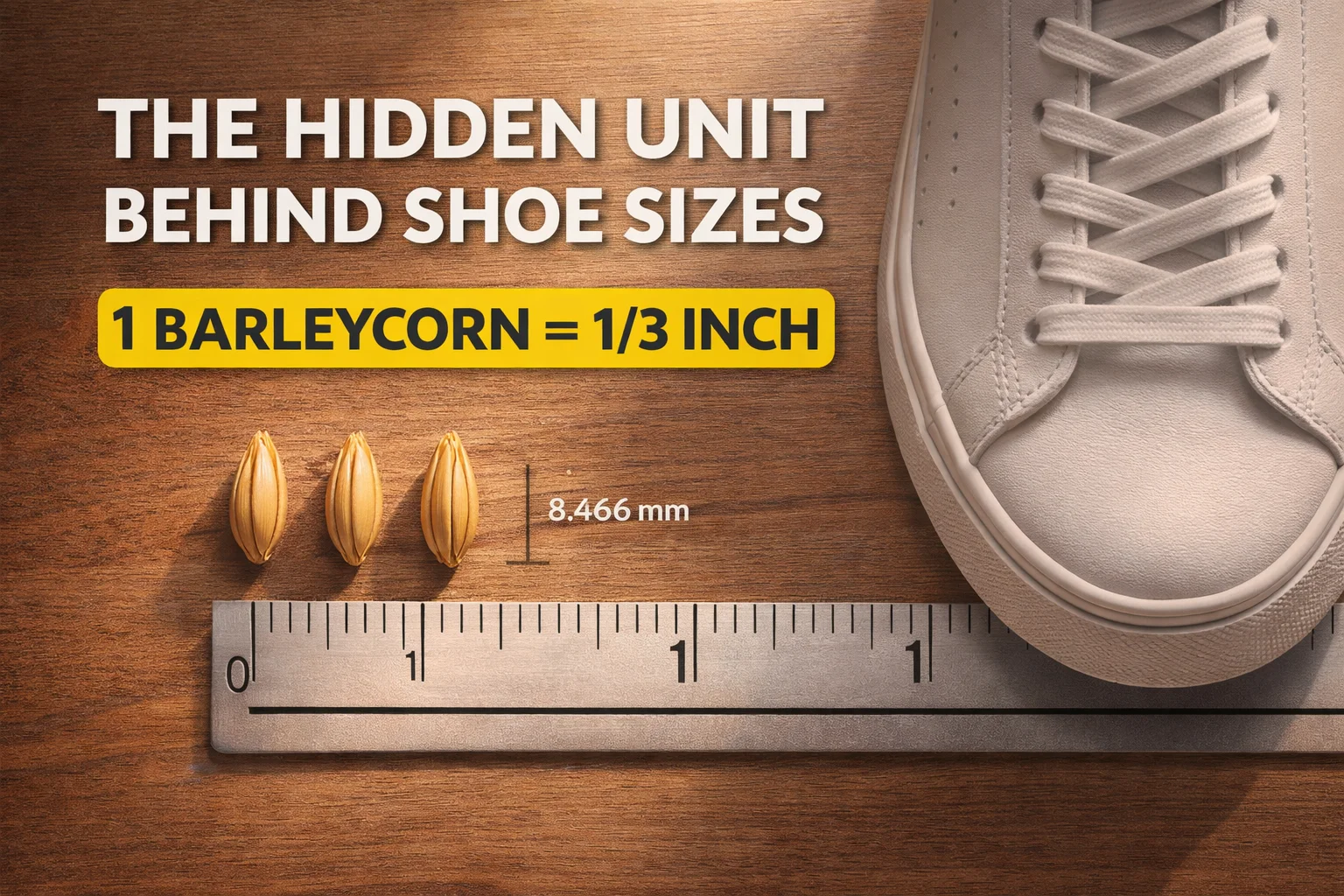
Every time you buy a shoe in the USA, you are using a 700-year-old grain of barley as your unit of measurement. That is not a metaphor. It is a fact.
The barleycorn measurement system is one of the oldest surviving units in the English-speaking world. It shaped the imperial system, standardized the shoe sizing system, and still quietly governs how American feet get fitted today.
This guide covers everything — the exact size in inches and millimeters, its ancient origins, how it became the backbone of US shoe sizes, and why it still matters in 2026.
What Is Barleycorn Measurement? (The Ancient Unit America Still Uses Without Knowing)
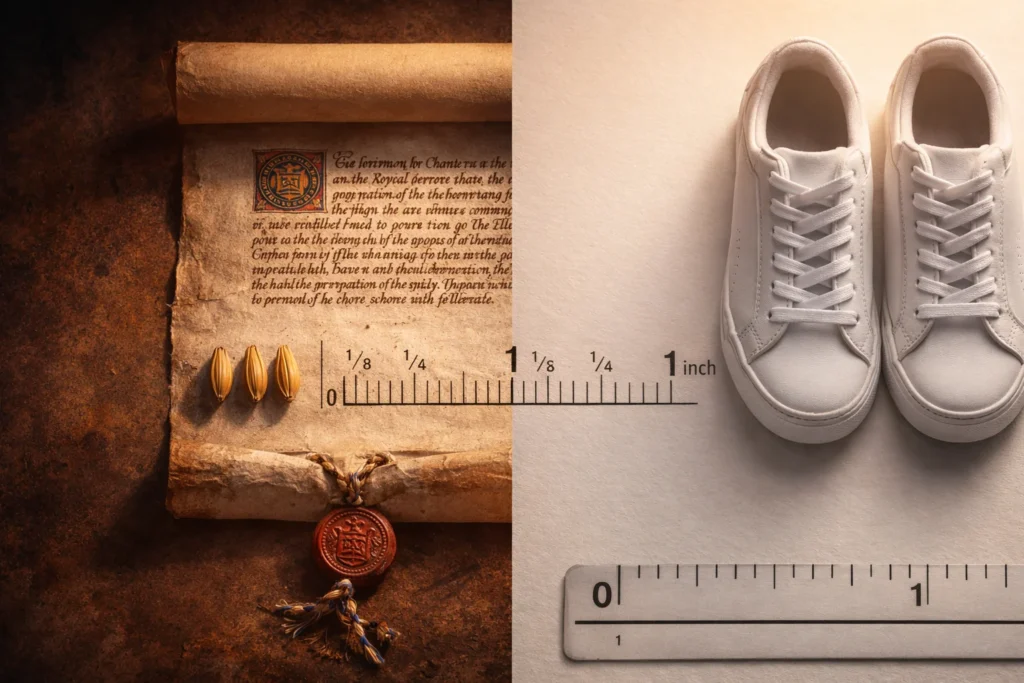
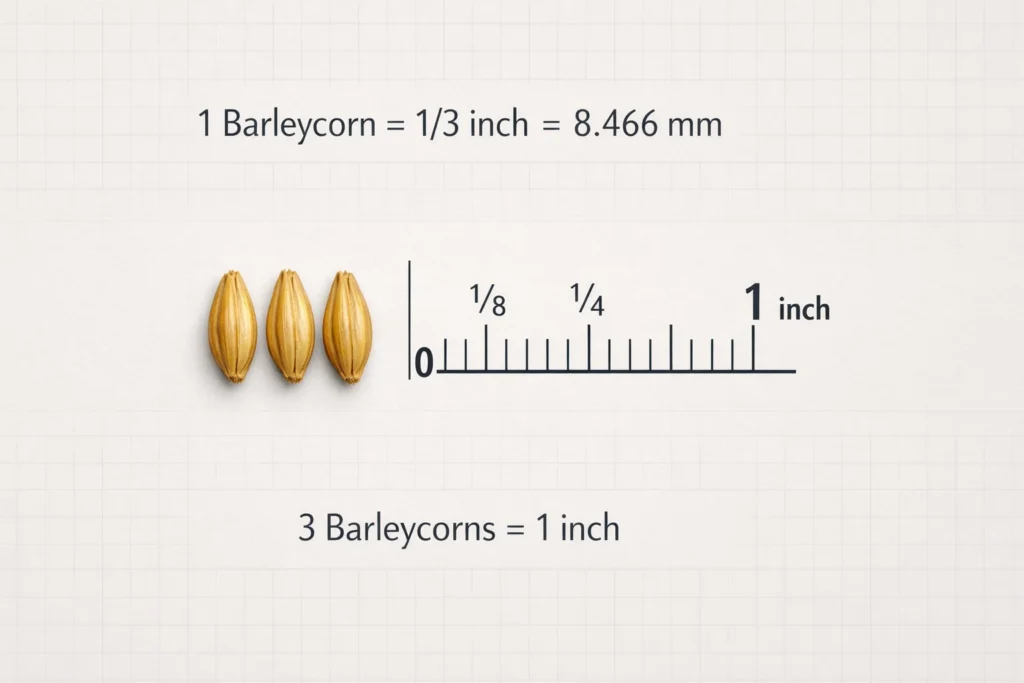
A barleycorn is a former English unit of length. It equals exactly one-third of an inch, or 8.466 millimeters. Three barleycorns laid end to end make one inch.
Quick Fact: 1 barleycorn = 1/3 inch = 8.466 mm. Three barleycorns = 1 inch. Twelve inches = 1 foot. This chain runs directly back to a single grain of barley.
Most Americans have never heard this term. Yet every time they ask for a size 10 shoe, they are ordering a foot covering that is exactly 10 barleycorns longer than the smallest standard size. The connection is that direct.
Must Visit: 15 Everyday Things That Are 2 Inches Long (Easy Real-Life Size Examples)
The Exact Barleycorn Size in Inches and Millimeters
Here is the precise breakdown of barleycorn measurement in modern units:
| Unit | Equivalent |
| 1 Barleycorn | 1/3 inch (0.3333 in) |
| 1 Barleycorn | 8.466 millimeters |
| 1 Barleycorn | 0.8466 centimeters |
| 3 Barleycorns | 1 inch (25.4 mm) |
| 4 Barleycorns | 1 poppyseed (1/4 barleycorn = 2.117 mm) |
| 36 Barleycorns | 1 foot (12 inches) |
Note: A quarter of one barleycorn is called a poppyseed — another ancient sub-unit of the British Imperial system that most people have never heard of.
From Ancient Grain to Royal Decree: How King Edward II Made It Official in 1324

The barleycorn unit did not begin in medieval England. Its roots go back nearly 4,000 years to the ancient Levant.
In ancient Mesopotamia and the Levant, 6 barleycorns equaled one Assbaas (a finger width). And 32 Assbaas equaled one cubit — the same cubit used in biblical measurements and ancient architecture.
By the time of King Edward II of England (1284–1327), trade was chaotic. Every merchant used a different inch. Every town had a different foot. Tradesmen, cobblers, and cloth merchants were constantly fighting over measurements.
In 1324, Edward II issued a royal decree standardizing English measurement:
“Three barley-corns, round and dry, make an inch, twelve inches a foot, three feet a yard, five and a half yards a perch, and forty perches in length and four in breadth an acre.”
This became one of the earliest standardized measurement systems in English history. The barleycorn was chosen not randomly — it was a grain available to almost everyone, relatively consistent in size, and already familiar to traders across the kingdom.
Later, the 1824 British Weights and Measures Act formalized these standards into law, building on Edward’s foundation and creating the imperial measurement system that the USA inherited and still uses today.
Must Visit: Buttload Measurement Explained: How Much Is a Buttload Really?
How Barleycorn Measurement Became the Foundation of American Shoe Sizing
This is where barleycorn measurement gets personal for every American shoe buyer. The entire US shoe size system is built on one simple rule: each full shoe size equals one barleycorn (1/3 inch) in foot length.
Go up one size? Your shoe is 1/3 inch longer. Go up half a size? That is 1/6 inch, exactly half a barleycorn. The system is mathematically clean — and nearly 400 years old.
The Exact US Shoe Size Formula Using Barleycorns (The Math Nobody Explains)
Most guides just say “each size equals 1/3 inch.” Nobody explains why the numbers start where they do. Here is the actual formula behind American shoe sizing:
Men’s US Size = (3 × foot length in inches) − 22 Women’s US Size = (3 × foot length in inches) − 21
So a man with a 10.33-inch foot (31 barleycorns long) wears a US men’s size 9. A woman with a 9.33-inch foot (28 barleycorns) wears a US women’s size 7. The math is direct and consistent.
This formula traces directly back to Randle Holme’s 1688 work, The Academy of Armory and Blazon, where the Guild of Shoemakers agreed on a precise sizing standard. Holme documented that:
“The Size of a shooe is the measure of its length… every fourth part of an inch is taken for a size.”
That “fourth part” was later refined. By 1856, Robert Gardiner introduced the 1/3-inch (one barleycorn) scale that became the modern English and American shoe sizing standard.
There is also a fascinating upper limit baked into the original system. The maximum shoe size was set at 13 — exactly 13 inches long. All other sizes counted downward in barleycorns from that anchor point. This is why children’s sizes count up to 13, and men’s sizes restart from 1 after that.
Of course, the system did not anticipate Shaquille O’Neal. Shaq wears a size 23 — meaning two pairs of average shoes fit inside one of his. The original system simply had no provision for feet that size.
UK vs US vs European Sizing: Where Barleycorns End and Paris Points Begin
| System | Unit Per Size | Notes |
| US (Men’s) | 1 barleycorn (1/3 in) | Constant: −22 |
| UK (Unisex) | 1 barleycorn (1/3 in) | Constant: −23 |
| European (EU) | 1 Paris Point (2/3 cm) | No barleycorns used |
| Mondopoint | Millimeters (foot length) | Global standard, rarely used retail |
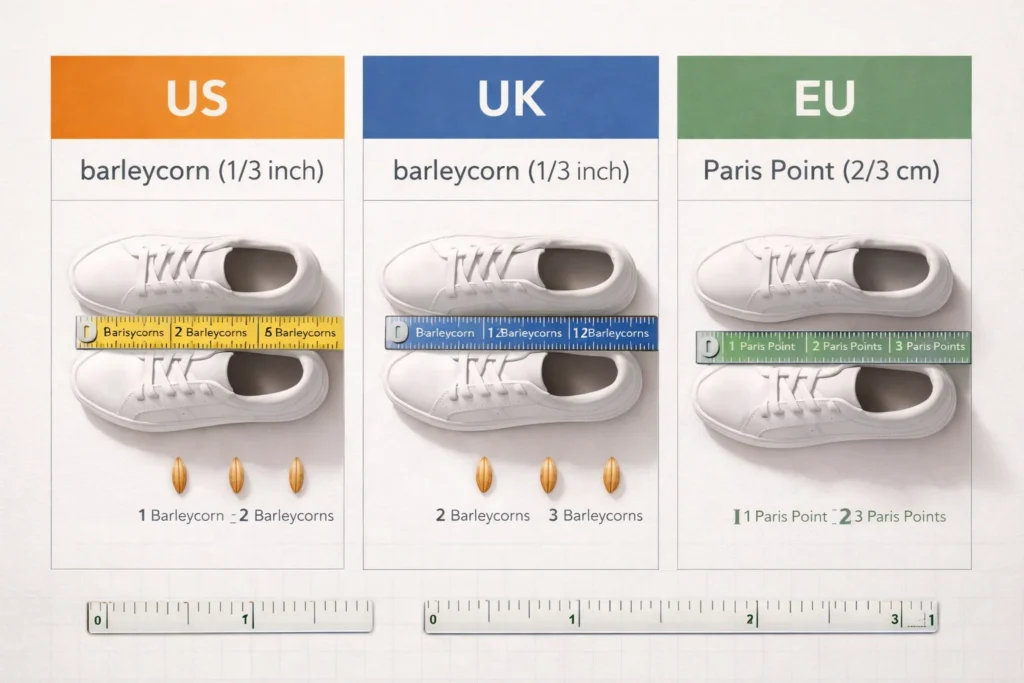
The UK system uses the same barleycorn increment but sets its constant at −23 (unisex), making a UK size 8 equal to a US men’s size 8.5. European sizing skips barleycorns entirely and uses the Paris Point system, where each size equals 2/3 centimeter. A EU size 42 is roughly a US men’s size 9.
The Mondopoint system — introduced as a global metric standard — measures foot length directly in millimeters. It is used by military and athletic organizations but has never taken hold in American retail. Barleycorns won that battle.
Barleycorn Measurement Beyond Shoes — Where Else This Unit Quietly Survived
Most people think barleycorn is only a shoe-sizing term. That is not accurate. For centuries, this unit appeared in multiple industries — some of which are quite surprising.
The Poppyseed, the Barleycorn, and the Inch — Understanding the Old Imperial Chain
The British Imperial measurement chain for small lengths looked like this:
1 poppyseed = 1/4 barleycorn (≈ 2.117 mm) 4 poppyseeds = 1 barleycorn (8.466 mm) 3 barleycorns = 1 inch (25.4 mm) 12 inches = 1 foot 3 feet = 1 yard 5.5 yards = 1 perch 40 perches = 1 acre (in length)
Every unit in this chain was body-based or grain-based. The poppyseed was the smallest standard length in the old English system — a quarter of a barleycorn. It shows how granular (literally) these measurements became.
Beyond shoes, the barleycorn unit appeared in:
Textile manufacturing: Medieval cloth merchants used barleycorn subdivisions for measuring fine fabric widths and rope diameters. The Guild of Shoemakers and textile guilds shared this standard.
Land surveying: Old English property deeds — especially pre-18th century documents — occasionally reference barleycorn subdivisions when describing precise boundary measurements.
Optical instruments: During the 18th and 19th centuries, some lens diameter measurements in England were expressed in barleycorns. This practice faded as optical engineering developed its own specialized measurement vocabulary.
Traditional leather crafts: Some British leather craftsmen still reference barleycorn increments for strap width and sole thickness measurements — a living tradition that never fully switched to metric.
Today, barleycorn measurement survives almost exclusively in footwear sizing. It is the last mainstream use of this ancient unit in everyday American life.
Why the USA Never Went Metric (And Why Barleycorn Measurement Still Matters in 2026)
This is a question millions of Americans have asked. If the metric system is simpler and more logical, why does the USA still use inches, feet, and barleycorn-based shoe sizes?
The answer is part history, part politics, part economics — and it directly explains why barleycorn measurement is still alive in American commerce today.
Cultural entrenchment: The USA inherited its measurement system from British Imperial standards before independence. By the time metric became a global push in the 19th century, American infrastructure, manufacturing, and trade were fully built around imperial units.
Legislative failure: Congress actually passed the Metric Conversion Act of 1975, making metric the preferred system. But it was voluntary — no mandate, no enforcement. The act changed almost nothing in daily life.
Industrial resistance: American manufacturers had enormous investments in imperial-standard machinery, tooling, and supply chains. Switching to metric meant replacing billions of dollars in equipment. The cost was prohibitive.
Consumer habit: American consumers think in feet, inches, pounds, and Fahrenheit. Shoe sizes in barleycorn increments are intuitive to anyone raised in the system. A size 9 feels meaningful; 266.7mm does not.
Modern Foot Scanning Technology vs. a 700-Year-Old Grain Standard
Here is what competitors miss entirely: 3D foot scanning and AI fitting algorithms are not replacing barleycorn measurement. They are working alongside it.
Companies like Nike, Adidas, and New Balance now use digital foot measurement tools that capture foot length, width, arch height, and volume. But the output of those scans is still expressed in barleycorn-based shoe size equivalents. The grain is still the anchor.
The real problem is brand inconsistency. A Nike size 10 is not the same physical shoe as an Adidas size 10. Manufacturing tolerances, design choices, and last shapes all vary. The barleycorn standard sets the increment, not the absolute internal dimension.
Research from footwear fitting studies shows that up to 72% of Americans wear the wrong shoe size — most often too narrow or slightly too short. This is not a failure of the barleycorn system. It is a failure to account for foot width, arch height, and volume — dimensions a single linear grain measurement was never designed to capture.
The takeaway for American shoe buyers: knowing your barleycorn-based size is a starting point, not a destination. Always measure both length and width. Factor in half sizes (half a barleycorn = 1/6 inch). And understand that a US size 9 in one brand may fit like a size 9.5 in another.
Frequently Asked Questions About Barleycorn Measurement
What is a barleycorn shoe size?
A barleycorn shoe size means each full shoe size increment equals one barleycorn in foot length — that is 1/3 of an inch or 8.466 millimeters. Going from a size 8 to a size 9 adds exactly one barleycorn. This applies to both US and UK shoe sizing systems. Half sizes add half a barleycorn, or 1/6 inch.
What is the measurement of a barleycorn?
One barleycorn equals precisely 1/3 of an inch, which is 8.466 millimeters or 0.8466 centimeters. Three barleycorns placed end to end equal exactly one inch. This was made an official English standard by King Edward II in 1324.
How many poppy seeds are in a barleycorn?
There are 4 poppyseeds in one barleycorn. A poppyseed is the smallest sub-unit in the old British Imperial length chain, equal to one-quarter of a barleycorn (approximately 2.117 mm). This micro-unit was used in historical measurement chains alongside the barleycorn and inch.
Is barleycorn a measure of distance?
Yes. A barleycorn is a unit of length (distance), not weight or volume. It equals 1/3 inch or 8.466 mm. It is classified under British Imperial Measure Before 1963 and is an ancestor of the modern imperial system still used in the USA. Its primary surviving use is in shoe size increments.
Why is 3 feet called a yard?
The word “yard” comes from the Old English word “gyrd” meaning rod or stick. Historically, a yard was the distance from the tip of the nose to the end of the outstretched arm — about 36 inches or 3 feet. King Edward I formally standardized it as exactly 3 feet (36 barleycorns × 3 = 108 barleycorns). It was one of the anchor points in the same 1324 royal decree that also standardized the barleycorn.
Why did the USA never go metric?
The USA did not go metric for four main reasons: cultural entrenchment in imperial units, industrial cost of retooling billions in manufacturing equipment, a voluntary-only Metric Conversion Act (1975) that had no enforcement power, and deep consumer preference for familiar units. The result is that Americans still buy shoes in barleycorn-based sizes — and likely will for the foreseeable future.
Conclusion — A Medieval Grain That Still Fits the Modern World
The barleycorn measurement is one of the oldest standards still actively used in American life. From King Edward II’s 1324 decree to the Guild of Shoemakers’ 1688 standard to every shoe purchase made in the USA today — this tiny grain never left.
One barleycorn = 1/3 inch = 8.466 mm. That is the number. Simple, ancient, and still accurate.
Understanding barleycorn shoe sizing makes you a smarter buyer. It explains size gaps between brands, the logic behind half sizes, and why US and UK sizes differ by exactly one barleycorn-based constant. Next time you order a size 9 shoe online, you are placing an order in a unit first standardized by a medieval English king — using grain from a barley crop that no longer exists.
That is the real story of barleycorn measurement. And now you know it.